
Technical publication
Back to publications
Industrial applications
Sonochemical Effect Induced by Hydrodynamic Cavitation
okozyuk.com
Published
Read complete publication for whole-document Find and printing. Browser Find and native printing on this reader include only loaded content.
12 Practical Applications
Hydrodynamic cavitation is most valuable when sonochemical reactions and mechanical process intensification reinforce each other. Applications that require only a highly uniform radical field at low throughput may favor acoustic or photochemical reactors. Applications involving continuous flow, high solids, gas liquid transfer, emulsification, particle activation, or integration into an existing pipe loop often favor hydrodynamic devices. The application map in Figure 12.1 positions representative uses by their relative dependence on chemical and mechanical mechanisms.
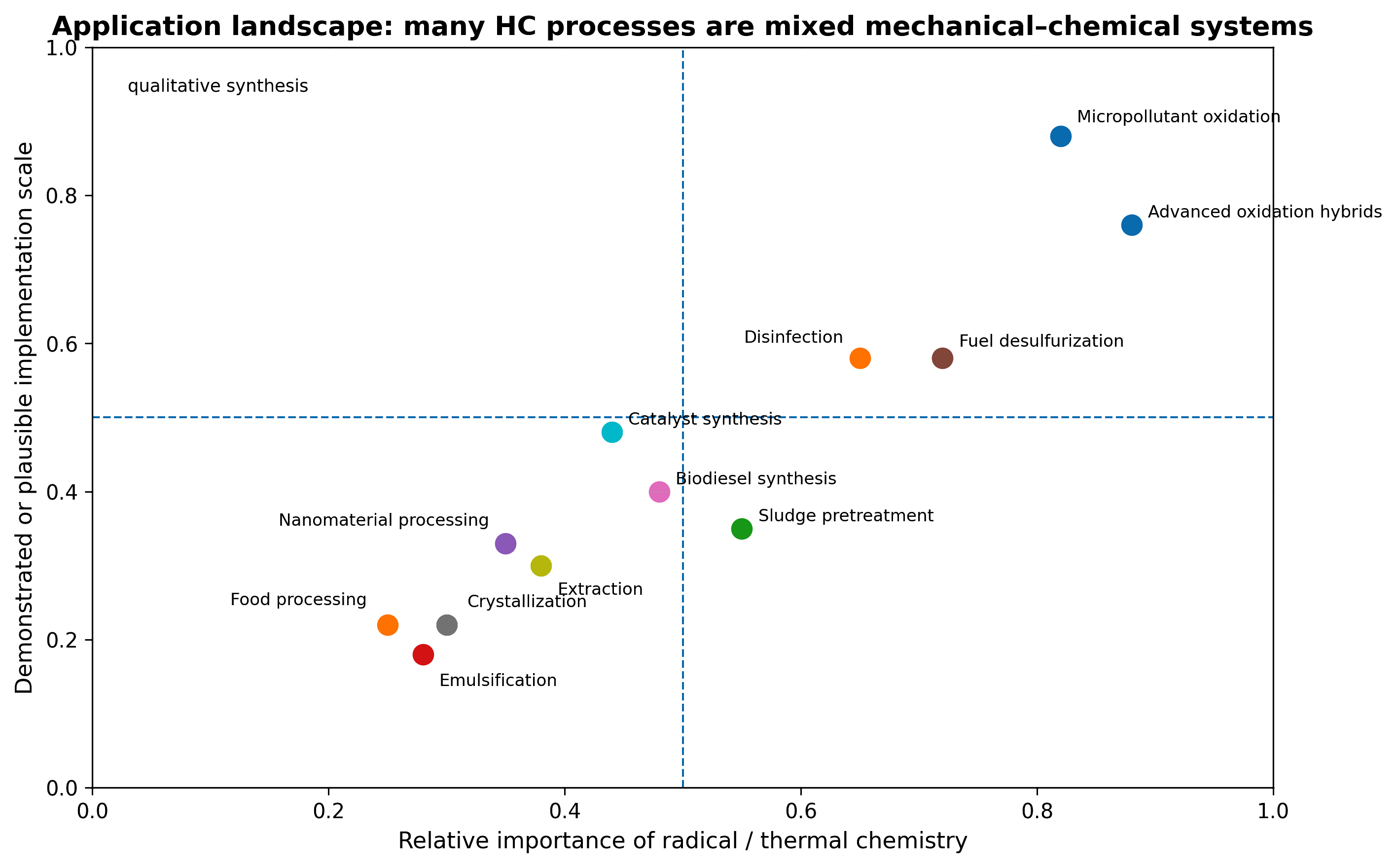
Figure 12.1. Application map for hydrodynamic cavitation. Position reflects the relative importance of radical/thermal chemistry and mechanical transport or disruption [81].
12.1 Water and wastewater treatment
For dissolved organic pollutants, direct hydrodynamic cavitation commonly provides partial conversion rather than complete mineralization. Performance improves when the target is interfacially enriched, the water matrix has low scavenging demand, or cavitation is combined with peroxide, ozone, Fenton chemistry, persulfate, aeration, photocatalysis, or electrochemistry [42,53-60]. p Nitrophenol, azo dyes, Rhodamine B, dichloroaniline, pharmaceuticals, surfactants, and many other compounds have been used as model or real targets. The design endpoint should include total organic carbon, chemical oxygen demand, toxicity, or biodegradability in addition to parent compound removal.
In real wastewater, bicarbonate, natural organic matter, chloride, suspended solids, and surfactants compete for radicals. Hydrodynamic cavitation can still be useful as pretreatment that breaks aggregates, improves biodegradability, or reduces the dose required in a downstream biological or oxidation step. The most economical configuration is often a short, high intensity cavitation stage followed by a lower energy residence or polishing process rather than attempting complete treatment in the cavitation device alone.
12.2 Disinfection and biological processing
Microorganism inactivation results from combined membrane stress, microjets, shear, shock waves, local pressure, and oxidative chemistry. Cell type, growth state, aggregation, and water matrix strongly affect sensitivity. Vortex based hydrodynamic cavitation has been demonstrated for pathogen reduction [61]. For sludge, biomass, and fermentation feedstocks, cell disruption or structural opening can improve solubilization and enzymatic accessibility [21-23,48-49,62]. Excessive treatment can release refractory material, inhibit enzymes, or consume more energy than the recovered product value.
12.3 Inorganic synthesis, crystallization, and catalysts
Cavitation can accelerate hydrolysis and precipitation, generate reducing radicals, produce unusual amorphous or nanostructured phases, and maintain dispersion during nucleation [19,45,63]. Controlled flow cavitation crystallization uses pressure cycling, micromixing, and mechanical stimulation to reduce induction time or control crystal size [43-44]. In catalyst fabrication, the same effects can increase precursor mixing, create defects, expose fresh surfaces, and reduce agglomeration. Product qualification must include phase composition, particle size distribution, surface area, impurity metals from erosion, and batch to batch reproducibility.
12.4 Organic synthesis, fuels, and multiphase reactions
Biodiesel and interesterification processes benefit primarily from intense dispersion between liquid phases and mass transfer, with possible contribution from local chemistry [46,64]. Deep desulfurization combines phase dispersion within situ oxidation of sulfur compounds [47]. Controlled flow cavitation has also been applied in commercial dry mill corn ethanol processing, where particle and cell structure changes improved conversion and ethanol yield [21-23]. In all such systems, downstream separation is part of reactor design. A stable emulsion can be beneficial during reaction but detrimental during decanting, centrifugation, or washing.
12.5 Food, beverage, and bioprocessing
Food and beverage applications exploit microbial reduction, extraction, emulsification, accelerated heating, particle reduction, and biochemical accessibility. Real scale beer brewing by controlled hydrodynamic cavitation demonstrates that industrial value can arise from the integrated thermal, mechanical, and chemical process rather than from radicals alone [65]. Oxidation sensitive foods require oxygen control because cavitation can initiate lipid oxidation or degrade flavors and vitamins. Sanitary design, clean in place compatibility, and low metal release are essential.
Table 12.1. Application matrix for hydrodynamic sonochemistry
| Application | Main cavitation mechanism | Useful performance metric | Critical constraint |
|---|---|---|---|
| Micropollutant oxidation | •OH and secondary oxidants | EEO, mineralization, toxicity | Water matrix scavenging |
| Hybrid ozone/peroxide/Fenton | Oxidant activation plus gas liquid transfer | Oxidant utilization and synergy | Residual reagent and pH control |
| Disinfection | Membrane disruption plus oxidative damage | Log reduction per kWh m⁻³ | Shielding by solids and regrowth |
| Sludge pretreatment | Cell disruption and solubilization | Soluble COD increase and net methane gain | Energy recovery and downstream inhibition |
| Nanoparticle synthesis | Hot spot chemistry and rapid quench | Yield, phase, size distribution | Contamination and scale up |
| Crystallization | Nucleation, attrition, and micromixing | Induction time, crystal size distribution | Over fragmentation and fouling |
| Emulsification | Microjets, shear, and interfacial renewal | Droplet size per energy | Recoalescence and separation |
| Biodiesel and liquid-liquid reaction | Mass transfer with possible local chemistry | Conversion and energy per mass product | Soap formation and phase recovery |
| Desulfurization | Oxidation plus phase dispersion | Sulfur removal and oxidant use | Solvent, phase ratio, extraction step |
| Biomass and ethanol | Particle disruption and accessibility | Product yield and net energy return | Feed variability and wear |
| Food and beverage | Mixing, extraction, microbial control | Quality adjusted throughput | Oxidation, sanitation, regulatory acceptance |