
Technical publication
Back to publications
Fundamentals
Single Cavitation Bubble Collapse: Phenomena, Theoretical Models, and Thermodynamic Effects
okozyuk.com
Published
Read complete publication for whole-document Find and printing. Browser Find and native printing on this reader include only loaded content.
4. The Thermodynamic Effect
4.1 Meaning of the Thermodynamic Effect
In cavitation research, the thermodynamic effect is the feedback of evaporation, condensation, latent heat, and temperature dependent material properties on bubble dynamics. It is sometimes described only as suppression of cavitation in cryogenic liquids, but the mechanism is broader and operates during both bubble growth and collapse.
During growth, liquid evaporates into the bubble. Vaporization consumes latent heat from the interface and adjacent liquid, causing the interfacial temperature to decrease. The resulting reduction in opposes further evaporation and can limit bubble growth.
During collapse, vapor condenses and releases latent heat. The interface can become warmer than the surrounding liquid. When condensation and heat removal are rapid, vapor mass decreases and the event approaches inertial cavity collapse. When these processes are slow, vapor is compressed and maintains a higher internal pressure. This vapor cushioning increases the minimum radius, reduces wall velocity, weakens the collapse shock, and can increase bubble symmetry by reducing the time available for an anisotropic jet to develop [9,25-29].
The thermodynamic effect therefore has two coupled components: a local temperature effect on phase equilibrium and a finite rate effect on mass transfer. Treating vapor pressure as a constant equal to the ambient saturation pressure does not fully represent either mechanism.
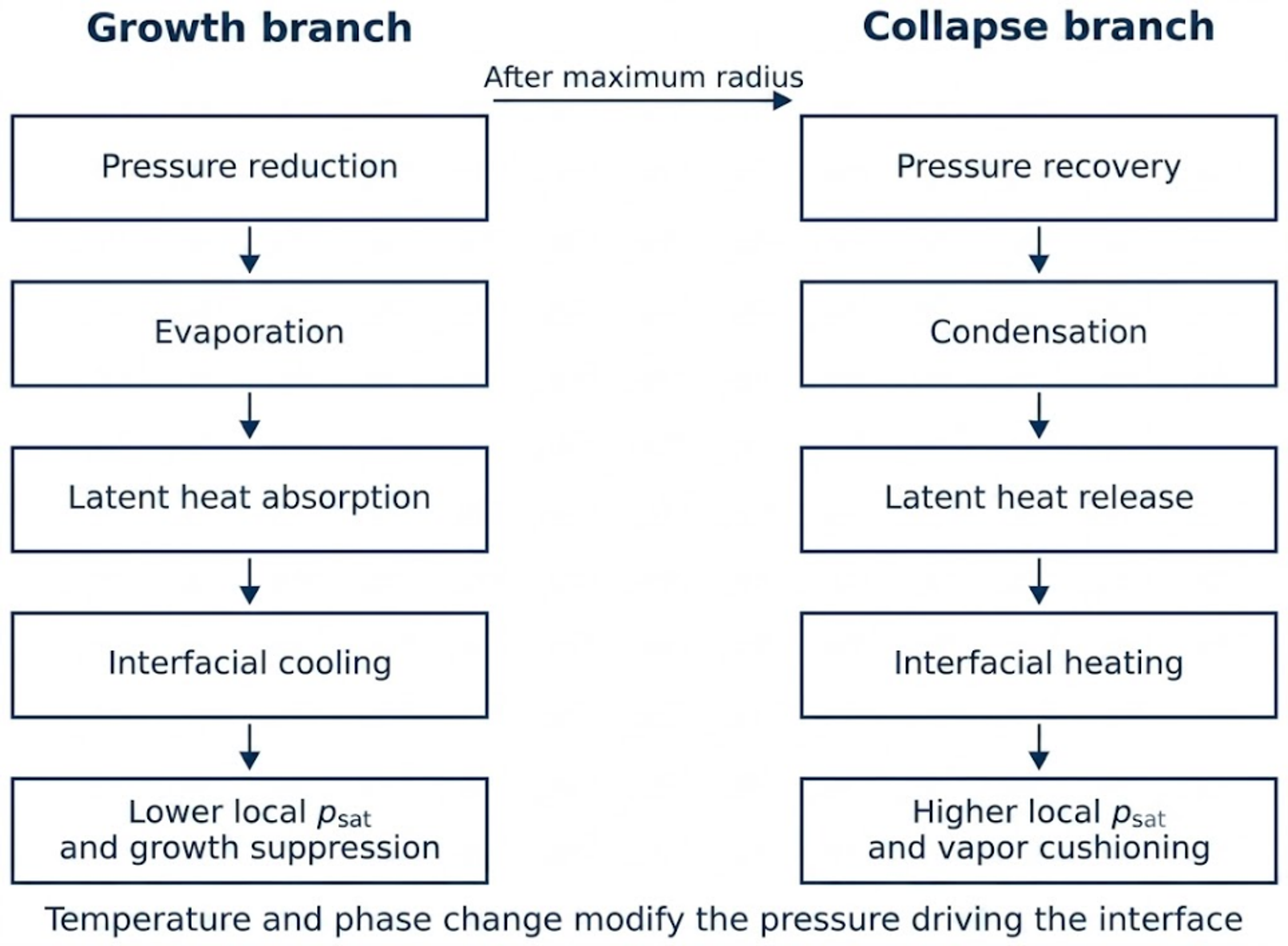
Figure 6. Thermodynamic feedback during bubble growth and collapse. [32]
4.2 Heat and Mass Balances
For a spherical bubble, the temperature field in the surrounding liquid can be written in simplified constant property form as:
The radial velocity advects the thermal boundary layer. A characteristic thermal penetration thickness is:
If , only a thin layer of liquid participates in rapid heat exchange. The bulk liquid can remain close to while the interface becomes several kelvin colder or hotter.
For a spatially uniform bubble interior, a useful energy balance is:
where is the heat transferred into the bubble and is positive for vapor entering the bubble. The final term carries the enthalpy associated with phase changing mass. A detailed model instead solves separate gas and vapor species equations and couples the work term to an appropriate real gas or mixture equation of state.
At the interface, conductive heat flux and latent heat must balance. Independent of sign convention, the magnitude of the latent heat demand is of order:
This scaling explains why a large latent heat combined with a limited conductive heat flux can produce a substantial local temperature departure. It also explains why thermodynamic effects can be strong even when the measured bulk liquid temperature remains nearly uniform.
4.3 Saturation Pressure Feedback
The Clausius Clapeyron relation connects phase equilibrium with temperature:
The approximation treats the vapor as ideal and neglects the specific volume of the liquid. Because the derivative increases with saturation pressure, the same interfacial temperature change has a much greater pressure effect at high temperature or in a volatile liquid.
For water, the IAPWS saturation correlation can be written as:
with coefficients specified in the IAPWS release [30]. Between 20 °C and 90 °C, the saturation pressure of water rises from approximately 2.34 kPa to 70.2 kPa. At one atmosphere, the nominal Rayleigh collapse driving pressure therefore decreases from about 99.0 kPa to 31.1 kPa.
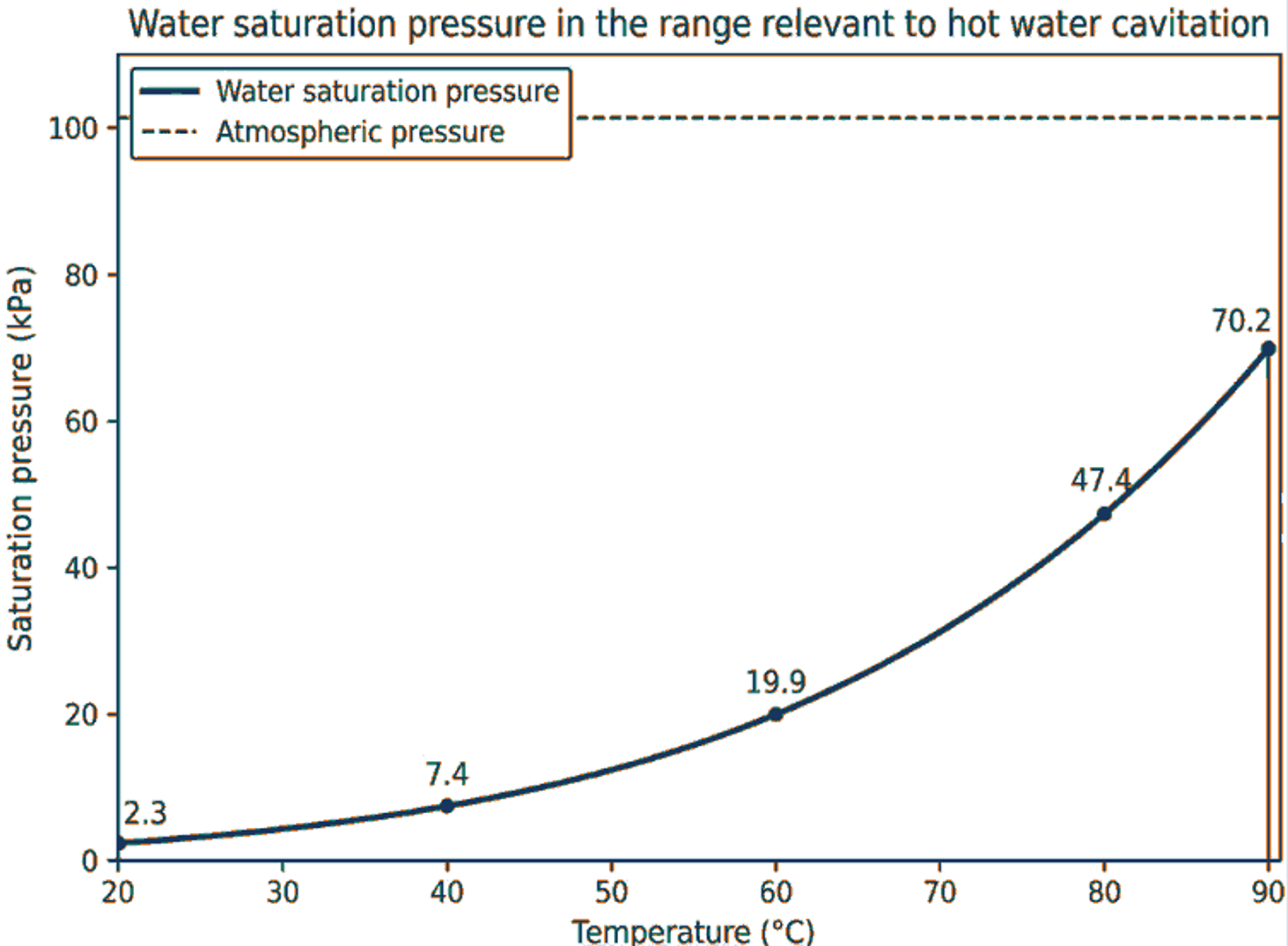
Figure 7. Saturation pressure of water calculated from the IAPWS correlation [30]. The dashed line represents standard atmospheric pressure.
The contribution of the pressure difference to collapse time follows:
Relative to 20 °C and assuming constant liquid density:
The calculated ratio reaches approximately 1.78 at 90 °C. This result isolates only the effect of the reduced pressure drive. Real bubble dynamics also depend on temperature dependent density, viscosity, surface tension, dissolved gas, heat transfer, and nonequilibrium phase change.
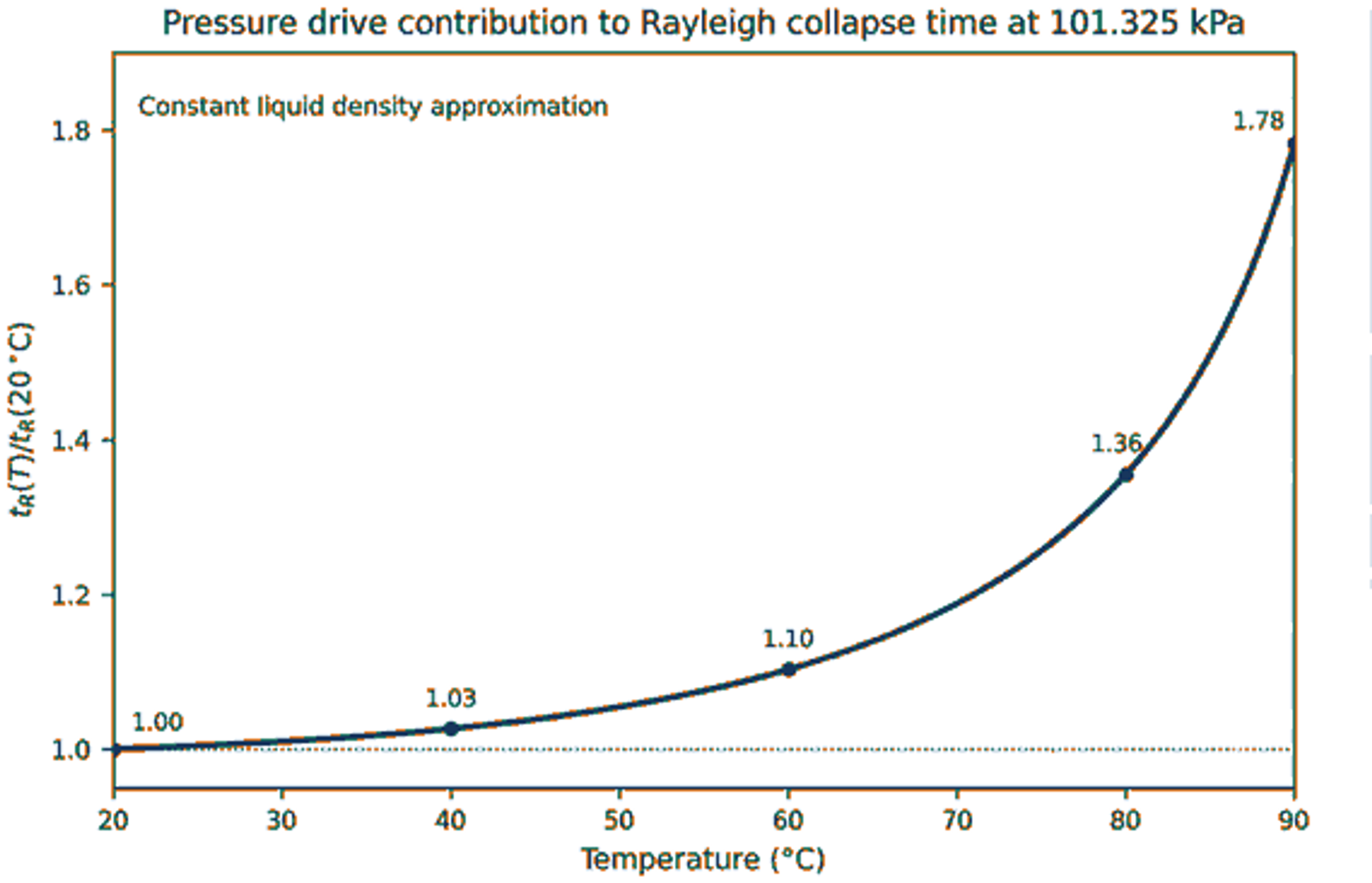
Figure 8. Normalized Rayleigh collapse time for water at 101.325 kPa, calculated using the IAPWS saturation pressure [30] and constant liquid density. The curve represents only the pressure drive contribution to the thermodynamic effect.
4.4 Effective Gas Behavior and Thermal Damping
The polytropic relation , where is constant for a prescribed polytropic process, provides an economical representation of gas thermodynamics. The exponent is not universal for an oscillating bubble. Prosperetti showed that thermal conduction makes the effective exponent and damping frequency dependent [7]. A slowly oscillating gas bubble approaches isothermal behavior because heat has time to cross the gas. During sufficiently rapid compression, the core tends toward adiabatic behavior while a thermal boundary layer persists near the interface.
A thermal Peclet number is:
The parameter compares interface motion with liquid thermal diffusion. Large values indicate that the interface moves faster than heat can diffuse across the bubble radius, producing a thin thermal layer. The Fourier number provides a complementary measure of diffusion. These groups can vary by orders of magnitude during one collapse because both and its rate of change vary rapidly.
Vapor introduces an additional relaxation process. If the condensation time is short compared with the collapse time, vapor pressure remains near equilibrium and vapor mass decreases rapidly. If condensation is slow, vapor behaves more like a compressible gas. This transition modifies both the effective stiffness and the energy dissipation and explains why the same radial equation can predict different shock amplitudes for different phase change closures [9,16].
4.5 Direct Measurements of Interfacial Temperature Change
Dular and Coutier Delgosha experimentally measured temperature variations around a single cavitation bubble [25]. They reported approximately 3 K of cooling in the liquid near the bubble during growth and up to approximately 4 K of heating during collapse. These measurements provide direct evidence that latent heat generates a transient thermal boundary layer even in room temperature water.
The reversal in sign is physically consistent. Evaporation during growth removes energy from the neighboring liquid, whereas condensation and compression during collapse return energy. Such measurements are experimentally difficult because the thermal layer is thin, the interface moves rapidly, and the curved surface distorts optical access. Measured temperature excursions should therefore be interpreted as spatially and temporally resolved values over a finite sensing volume rather than exact molecular interface temperatures.
These measurements also demonstrate why bulk temperature alone is insufficient. A liquid bath can remain nearly isothermal while the bubble interface undergoes a substantially larger transient temperature excursion. Models that impose at all times cannot capture this local feedback.
4.6 Ambient Temperature Effects in Water
Phan and coauthors examined single bubble dynamics in water across a broad ambient temperature range [26]. They found that maximum radius, first minimum radius, and collapse time increased with temperature, while predicted peak internal pressure and temperature decreased. The trend is consistent with a smaller collapse driving pressure and stronger vapor cushioning as saturation pressure increases.
Pei and coauthors extended the measurements to 23 °C through 90 °C in free field and near wall configurations [29]. They reported a monotonic weakening of collapse with temperature, reflected in the Rayleigh factor, minimum bubble volume, maximum collapse velocity, jet velocity, and bubble migration. Above approximately 70 °C, secondary cavitation nuclei appeared near the primary bubble surface around maximum expansion and subsequently contributed to surface wrinkling, instability, and fission.
Several mechanisms act simultaneously as water temperature increases:
-
increases sharply, thereby reducing at fixed ambient pressure.
-
A larger quantity of vapor can be present in the bubble at maximum radius.
-
Condensation must remove a greater vapor mass during collapse.
-
Latent heat exchange produces stronger coupling between pressure and temperature.
-
Viscosity and surface tension decrease, which can promote deformation even as radial collapse weakens.
-
Dissolved gas solubility and nucleation conditions change.
The resulting collapse is generally slower and less intense, but not necessarily simpler. Elevated temperature can reduce peak shock pressure and jet velocity while increasing instability, secondary cavitation, and fragmentation. A model that changes only captures the leading pressure effect but not the complete behavior.
4.7 Cryogenic Liquids
Cryogenic cavitation frequently exhibits strong thermodynamic effects because vapor density is relatively high and latent heat consumption can cool the liquid appreciably. Chen and coauthors compared single bubbles in liquid nitrogen with bubbles in room temperature water at similar ambient pressure [28]. Their experiments and model indicated a weaker collapse in liquid nitrogen. In the reported comparison, the minimum bubble radius was more than three times the value in water, and the maximum wall Mach number was approximately one fifth of the water value. The authors attributed the difference to the smaller effective pressure difference and to strong heat and mass transfer.
This result illustrates an important distinction. A cryogenic liquid can exhibit a large thermodynamic effect despite its low absolute temperature. The controlling factors are the saturation pressure slope, vapor density, latent heat, thermal conductivity, heat capacity, and available thermal subcooling. Cavitation in cryogenic pumps and rocket propellants therefore cannot be extrapolated directly from room temperature water experiments by matching only a conventional cavitation number.
A useful qualitative parameter is the Jakob number:
A small indicates that limited sensible heat is available relative to the latent heat required to create vapor, so local cooling can strongly suppress evaporation. Definitions vary across the cavitation literature, and comparisons require consistent reference temperatures and vapor density conventions.
4.8 High Vapor Pressure Mixtures
Preso and coauthors used aqueous ammonia to vary condensable vapor pressure while retaining a water based liquid system [27]. Increasing ammonia concentration increased vapor pressure and modified the collapse. Bubbles with higher vapor pressure resisted collapse, dissipated less total energy, and remained more spherical. The experiments also showed that vapor can be compressed far from equilibrium during collapse.
Mixtures introduce additional physical processes. Vapor composition can differ from liquid composition, individual species have different volatilities, diffusion rates can differ, and condensation can preferentially enrich one component. A single saturation pressure relation is therefore insufficient. Vapor liquid equilibrium, species diffusion, and mixture thermodynamics must be coupled to the bubble dynamics. The aqueous ammonia experiments are particularly useful because they separate vapor pressure effects from a simple change in bulk liquid temperature.
4.9 Consequences for Shock, Jet, Rebound, and Erosion
Thermodynamic effects modify every major output of bubble collapse.
Shock wave. Higher retained vapor pressure limits the maximum inward velocity and moderates the pressure rise near minimum radius. The principal collapse shock is therefore generally weaker. Nonequilibrium condensation can nevertheless generate a sharp pressure transient when vapor is compressed and then condenses rapidly [9].
Microjet. A lower pressure difference reduces the characteristic jet velocity. Pei and coauthors observed lower near wall jet velocity and reduced migration as temperature increased [29]. However, a longer collapse time can allow some perturbations to grow, while reduced surface tension can increase interface distortion. Jet strength and jet geometry must therefore be evaluated together.
Rebound. Retained vapor and permanent gas increase the minimum radius and can supply energy to the rebound. At the same time, a weaker collapse can reduce shock energy loss. A comparatively large rebound does not necessarily indicate a more violent collapse and may instead reflect stronger cushioning.
Erosion. Lower shock pressure and jet velocity generally reduce the severity of individual impacts. This mechanism contributes to the reduction of cavitation erosion that can occur at elevated temperature or in cryogenic liquids. Material properties also vary with temperature, and cloud scale cavitation can differ from single bubble behavior. Single bubble measurements isolate the hydrodynamic contribution but do not independently predict component service life.
Optical and chemical output. Additional vapor increases heat capacity and endothermic dissociation, reducing peak temperature and potentially suppressing light emission or altering radical yields [13,16-18]. A more spherical but vapor rich bubble can therefore produce weaker luminescence than a drier bubble having the same maximum radius.
4.10 Modeling Recommendations for Thermodynamic Regimes
A thermodynamically consistent single bubble calculation should include, at minimum:
-
A compressible radial equation, normally Keller Miksis or Gilmore, when collapse shock or rebound is required.
-
Separate partial pressures for permanent gas and vapor.
-
An energy equation for the bubble contents, with temperature dependent heat capacities when required.
-
A liquid thermal diffusion model or a validated thermal boundary layer approximation.
-
A phase change law driven by .
-
Temperature dependent liquid density, viscosity, surface tension, sound speed, latent heat, and saturation pressure.
-
A real fluid equation of state for cryogenic liquids or very high pressure collapse.
-
Validation against and at least one energy related quantity, such as rebound radius, shock pressure, or interfacial temperature.
A constant vapor pressure Rayleigh Plesset model remains useful for preliminary estimates, but its limitations should be stated explicitly. In water at atmospheric pressure, this limitation becomes increasingly important above approximately 60 °C to 70 °C because saturation pressure becomes a large fraction of ambient pressure. In cryogenic liquids and volatile mixtures, a phase change model is part of the primary force balance rather than an optional refinement.
Table 4. Representative experimental observations of thermodynamic effects in single bubbles.
| Study | Liquid and condition | Main observation | Modeling implication |
|---|---|---|---|
| Dular and Coutier Delgosha [25] | Water near ambient conditions | About 3 K cooling during growth and up to about 4 K heating during collapse | Resolve a transient liquid thermal layer and local temperature feedback |
| Phan et al. [26] | Water, 20 to 80 degrees Celsius | Longer collapse and larger minimum radius at higher temperature; lower predicted peak pressure and temperature | Include temperature dependent saturation pressure and heat transfer |
| Preso et al. [27] | Water and aqueous ammonia | Higher vapor pressure resisted collapse and reduced total energy dissipation | Model mixture vapor composition and nonequilibrium compression |
| Chen et al. [28] | Liquid nitrogen compared with water | Larger minimum radius and much lower maximum Mach number in liquid nitrogen | Use cryogenic properties, phase change, and variable compressibility |
| Pei et al. [29] | Water, 23 to 90 degrees Celsius | Monotonic collapse weakening, lower jet speed, secondary cavitation above about 70 degrees Celsius | Couple thermal attenuation with instability and nucleation behavior |