
Technical publication
Back to publications
Fundamentals
Single Cavitation Bubble Collapse: Phenomena, Theoretical Models, and Thermodynamic Effects
okozyuk.com
Published
Read complete publication for whole-document Find and printing. Browser Find and native printing on this reader include only loaded content.
1. Introduction
Cavitation is the formation and subsequent evolution of vapor or gas vapor cavities in a liquid when the local pressure becomes sufficiently low. A single cavitation bubble is the simplest experimentally accessible unit of this process. It can be generated by a focused laser pulse, an electric discharge, a rapid pressure reduction, a tensile acoustic pulse, or localized heating. When the pressure recovers, the surrounding liquid accelerates inward and the cavity collapses. The term cavitation bubble is appropriate because a substantial portion of the bubble volume is commonly produced by vaporization of the liquid, although permanent gas and products of the generation process may also be present.
The classical theoretical foundation begins with Rayleigh's analysis of an empty spherical cavity in an incompressible inviscid liquid [1]. Plesset extended the radial dynamics to include bubble pressure, viscosity, and surface tension [2]. These models establish the characteristic inertial time scale and explain the rapid acceleration that occurs during the final stage of collapse. They also contain an ideal mathematical singularity. If the cavity were empty, perfectly spherical, and surrounded by an incompressible liquid, the interface velocity and pressure would diverge as the radius approached zero. Real bubbles are regularized by liquid compressibility, gas compression, vapor condensation, heat transfer, viscosity, and loss of spherical symmetry. Gilmore and Hickling and Plesset demonstrated how compressibility permits pressure wave emission and rebound dynamics to be represented [3,4].
A bubble seldom collapses in a perfectly uniform environment. Gravity, background pressure gradients, neighboring interfaces, and especially nearby solid boundaries introduce anisotropy. The side exposed to the larger pressure impulse moves faster, and a high speed liquid microjet can penetrate the bubble. Early boundary studies established the relation among collapse asymmetry, impulsive pressure, and material damage [5,6]. Thermal theory also showed that the gas response cannot always be represented by a constant polytropic exponent and that heat transfer contributes both stiffness and damping [7]. Compressible radial equations developed by Keller and Miksis, Fujikawa and Akamatsu, and Prosperetti and Lezzi improved the treatment of acoustic radiation, nonequilibrium condensation, and finite sound speed [8-11].
High speed optical and acoustic experiments have resolved the sequence of bubble growth, inertial collapse, shock emission, jetting, rebound, and fragmentation [12]. Under sufficiently strong compression, the bubble interior can reach temperatures and pressures that produce sonoluminescence and chemical reactions. Models and measurements by Yasui, Pecha and Gompf, Storey and Szeri, Didenko and Suslick, and Flannigan and Suslick established that the peak internal state depends strongly on water vapor, heat transfer, ionization, and the duration of the final compression [13-18].
Theoretical analysis has also progressed beyond spherical symmetry. Weakly compressible boundary integral formulations describe bubble migration, deformation, jet penetration, and repeated topology changes [19-21]. Energy measurements and scaling laws relate shock, rebound, and jet energies to the initial potential energy and to a nondimensional anisotropy parameter [20,22-24]. More recent experiments have measured thermal fields around individual bubbles and quantified the effects of ambient temperature, vapor pressure, and cryogenic fluids [25-29]. Saturation property correlations issued by the International Association for the Properties of Water and Steam provide the thermodynamic basis for quantifying the strong increase in water vapor pressure with temperature [30].
The central premise of this article is that bubble collapse is an energy focusing process governed by five coupled mechanisms: inertial liquid motion, liquid compressibility, bubble contents, geometric asymmetry, and thermodynamic exchange. These mechanisms determine how the initial bubble energy is partitioned among shock waves, jets, rebound, vortical motion, heat transfer, phase change, and chemical or optical effects.
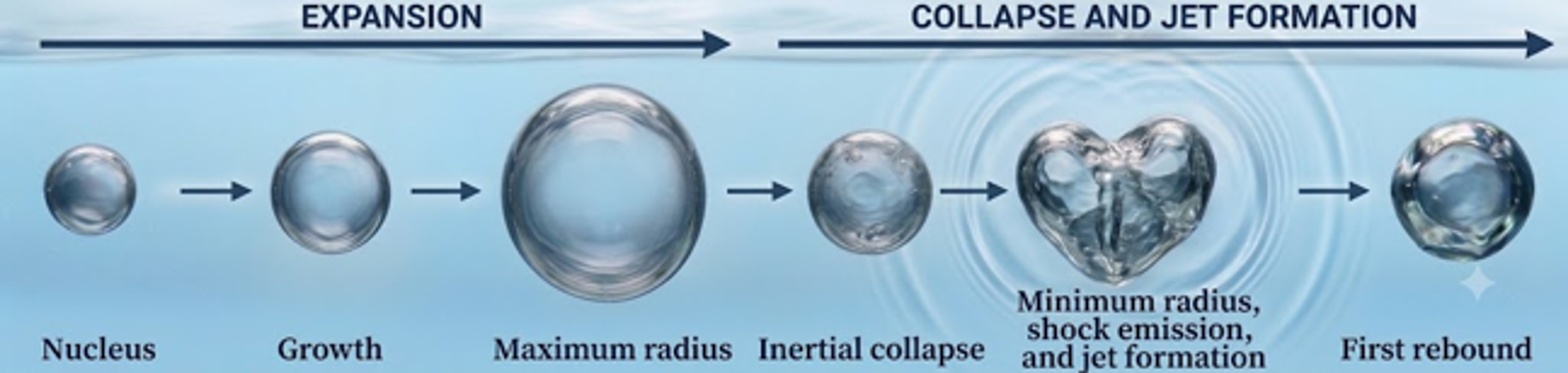
Figure 1. Idealized life cycle of an isolated cavitation bubble.[32]