
Technical publication
Back to publications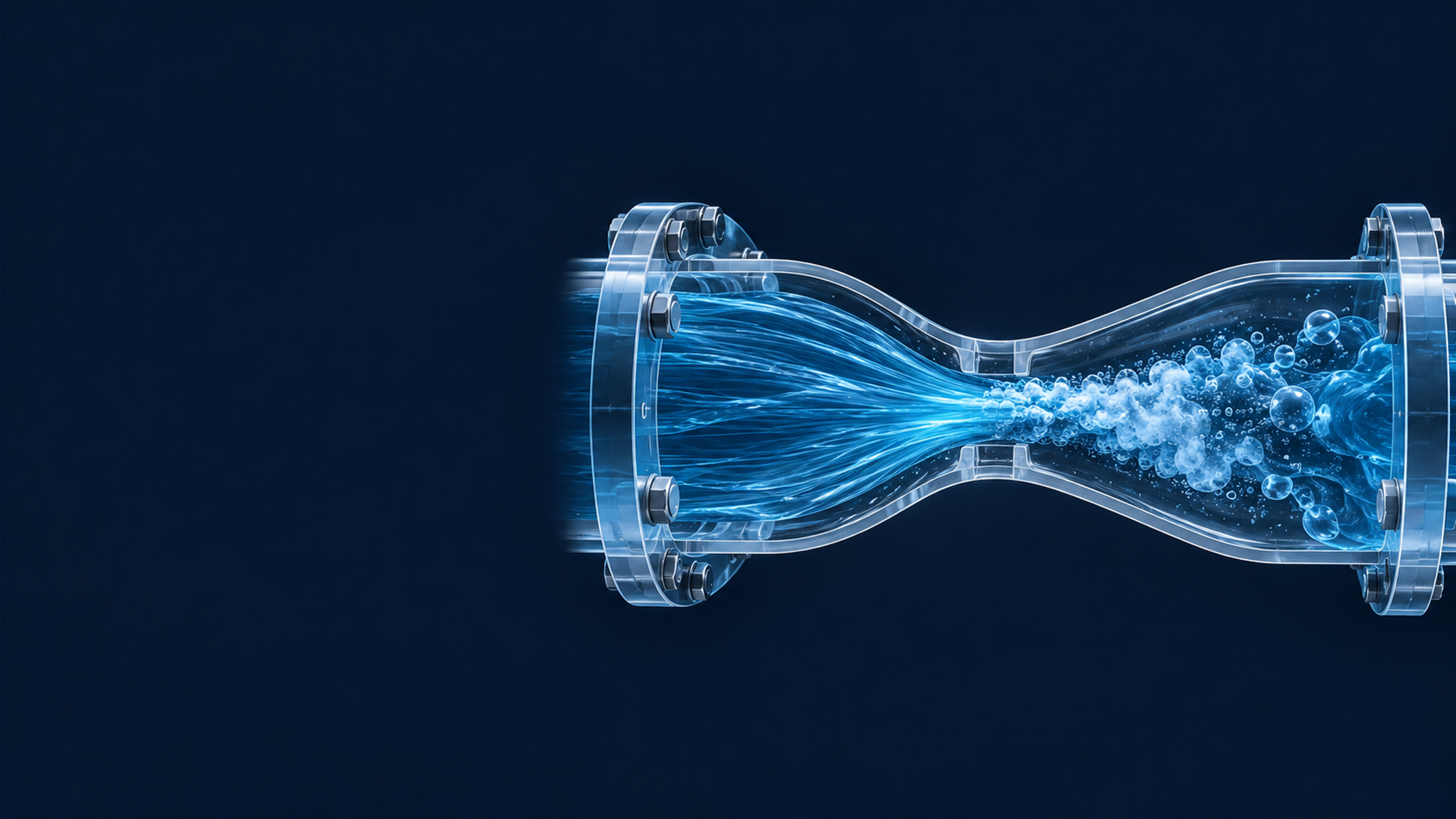
Fundamentals
Physical Basis of Hydrodynamic Cavitation Generation
okozyuk.com
Published
Read complete publication for whole-document Find and printing. Browser Find and native printing on this reader include only loaded content.
Physical Basis of Hydrodynamic Cavitation Generation
Abstract
Hydrodynamic cavitation is generated when flow acceleration or vortical motion reduces local static pressure sufficiently to permit the formation of vapor and gas cavities, followed by pressure recovery and collapse. This article examines the physical basis of cavitation inception and hydrodynamic generation, with emphasis on conservation of flow, mechanical energy balance, cavitation number, pressure recovery, liquid properties, and the role of nuclei. The principal families of static and dynamic cavitation devices are compared, including orifice plates, multihole plates, Venturi restrictions, vortex chambers, rotor stator systems, and multistage baffles. The analysis shows that cavitation intensity cannot be characterized by pressure drop or cavitation number alone. Collapse behavior also depends on downstream pressure recovery, gas content, temperature, viscosity, interfacial tension, residence time, void fraction, and cavity transport. Collective cloud behavior further limits the applicability of single bubble descriptions. A physically meaningful engineering assessment therefore requires explicit definition of reference pressures and velocities together with complementary dimensionless groups and process performance metrics. These considerations provide a consistent framework for comparing cavitation devices, identifying operating regimes, and controlling the location and intensity of cavity collapse.