
Technical publication
Back to publications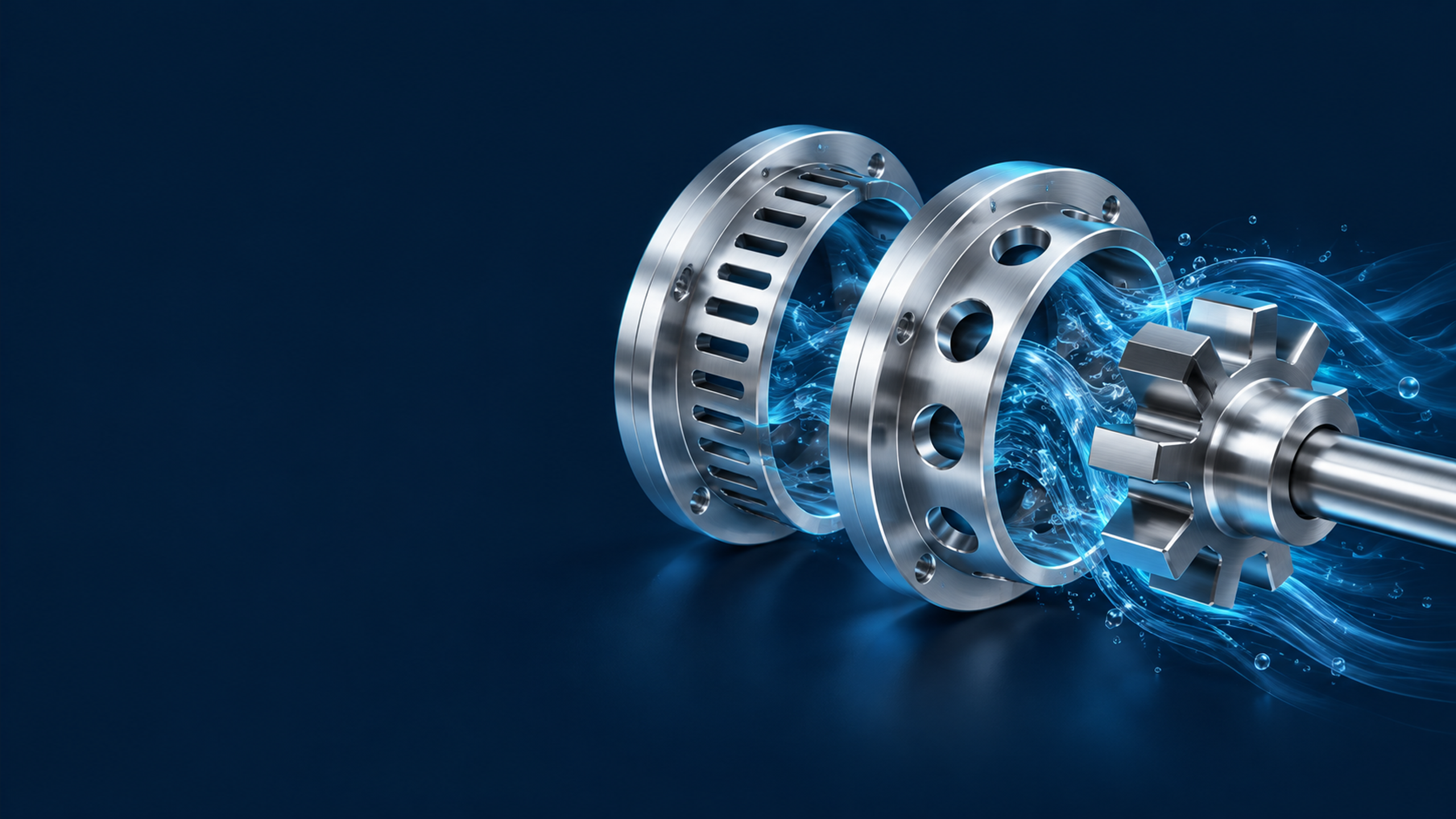
Other
Performance considerations in stator selection for high shear rotor-stator mixers
okozyuk.com
Published
Read complete publication for whole-document Find and printing. Browser Find and native printing on this reader include only loaded content.
8. Engineering selection rules
Rule 1
When selection uncertainty exists, prioritize macroscopic circulation and batch turnover before maximizing local shear intensity. A rotor-stator head that generates very high shear in a small hydraulic capture zone can underperform a slightly less aggressive geometry that entrains a larger fraction of the vessel contents per unit time. In practical terms, whole batch processing rate is often controlled as much by pumping capacity and recirculation pattern as by tip zone stress. For scale up and process robustness, first confirm that the selected head can sustain adequate top to bottom turnover, eliminate stagnant regions, and repeatedly return unprocessed material to the work head.
Rule 2
Use fine screen geometry as a finishing step rather than as the primary incorporation tool. Fine emulsor or fine perforated stators impose higher hydraulic resistance, narrower flow passages, and greater sensitivity to viscosity growth, powder loading, and soft agglomerates. That makes them better suited to late stage droplet size reduction or final dispersion refinement after the formulation is already wetted, deagglomerated, and flowing consistently. In early stage mixing, a less restrictive head usually gives better solids acceptance, lower plugging risk, and more stable throughput.
Rule 3
In high viscosity service, improve system level flow before escalating stator restriction. As viscosity rises, rotor-stator performance becomes increasingly limited by material transport into and out of the active zone. Under those conditions, selecting a finer stator alone often increases pressure drop and reduces effective circulation without proportionally improving real process intensity. The better engineering solution is frequently a rotor-stator head paired with an auxiliary flow generating device such as an anchor, scraper, sweep agitator, or dedicated recirculation loop. This keeps fresh material moving through the shear zone and prevents the process from becoming locally intense but globally inefficient.
Rule 4
For fibrous, deformable, or gummy feedstocks, default toward slotted stators unless fouling data proves that a perforated screen will remain open. These materials tend to bridge, mat, or smear across round or square perforations, which reduces open area, increases pressure drop, and destabilizes throughput. Slot geometry generally provides a more tolerant flow path, better resistance to blinding, and more reliable passage of elongated or elastic structures. The decision should be based on expected particle morphology under shear, not only on nominal starting particle size.