
Technical publication
Back to publications
Industrial applications
Hydrodynamic Cavitation in Pharmaceutical Particle Engineering, Crystallization, and Drug Delivery
okozyuk.com
Published
Read complete publication for whole-document Find and printing. Browser Find and native printing on this reader include only loaded content.
3 Processing Platform Selection
3.1 Top Down and Bottom Up Strategies
Top down processing begins with a coarse solid, agglomerate, droplet, or vesicle and applies mechanical stress until the structure reaches a limiting size. The limit may be imposed by crystal strength, primary crystal dimensions, interfacial tension, stabilizer coverage, viscosity, channel size, or a balance between breakup and recoalescence. Bottom up processing begins with dissolved species and controls the rate of supersaturation generation, nucleation, growth, and stabilization. Bottom up crystallization can create particles below the primary crystal size of the feed because the particles are formed rather than broken [26,27,29,30].
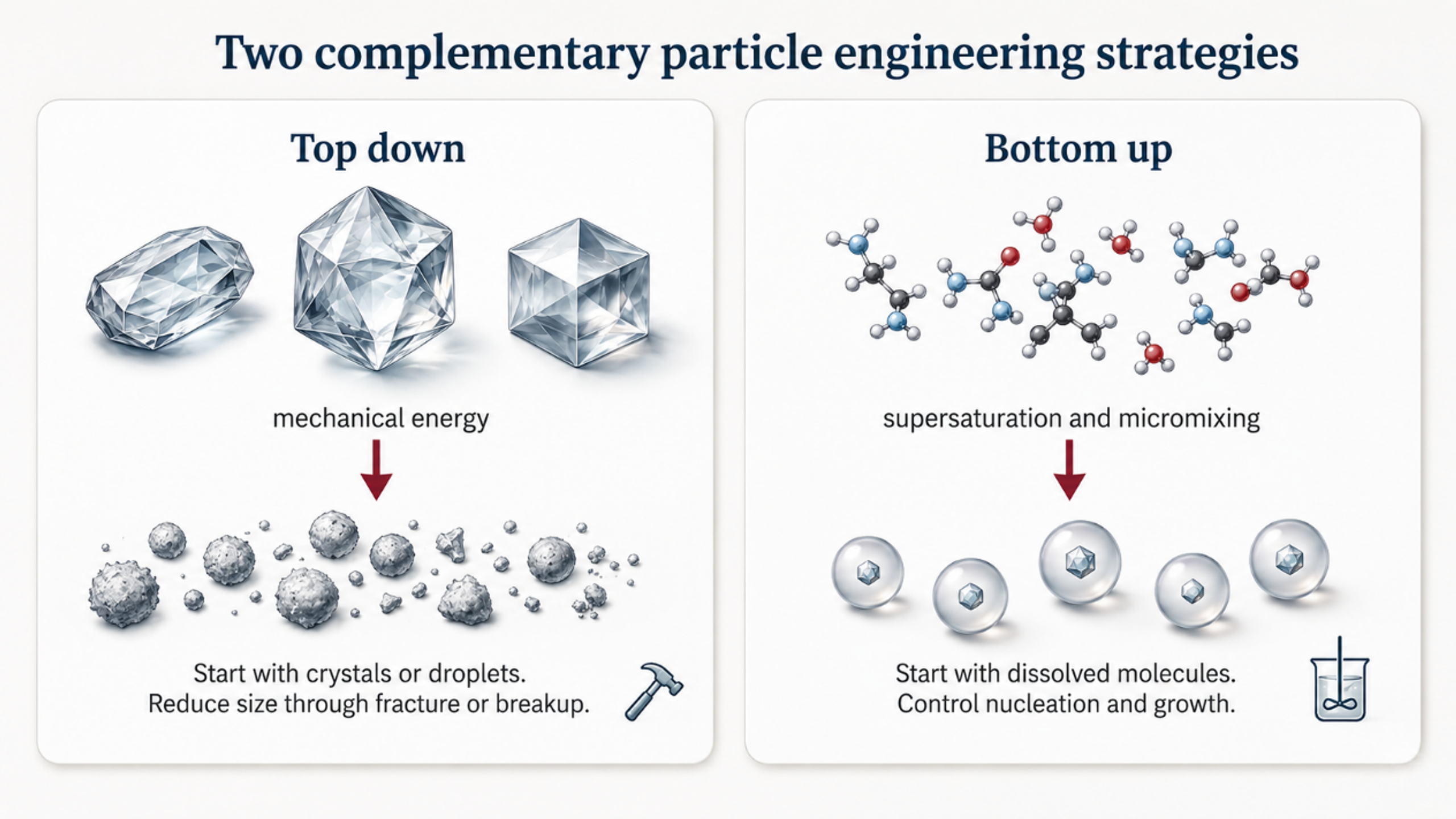
Figure 3.1. Top down size reduction and bottom up crystallization as complementary particle engineering strategies [42].
A hybrid route is often preferable. For example, controlled antisolvent crystallization can create a narrow nanosuspension, followed by a short low severity pass to break weak agglomerates and establish final dispersion. A liposome process can use self-assembly to create vesicles, then high pressure processing to reduce lamellarity and size, followed by extrusion or sterile filtration. A cavitation crystallizer can use cavity collapse both to intensify nucleation and to fragment crystals that become too large, thereby increasing secondary nucleation [1,29,30].
3.2 Technology Selection Criteria
Technology selection should begin with the product target and failure modes. Dry jet milling is attractive when a dry powder is required and heat or solvent exposure must be avoided, but it may generate electrostatic charging, broad tails, or amorphous content. Wet media milling can reach the nanometer scale but introduces media wear, separation, and cleaning considerations. Rotor stator systems are simple and scalable but usually have lower local energy density. High pressure homogenizers and Microfluidizer processors are established for emulsions, nanosuspensions, and liposomes. Controlled hydrodynamic cavitation is attractive when pressure recovery and cavity collapse can be engineered for continuous processing, particle breakage, nucleation, or surface treatment. MRT and related impinging jet crystallizers are particularly useful when fast antisolvent mixing is the controlling step [17–35,40,41].
| Technology | Submicron potential | Media free | Continuous operation | Crystal formation control | Liposome suitability | Scale up transparency |
|---|---|---|---|---|---|---|
| Rotor stator | conditional | strong | strong | limited | conditional | strong |
| Wet media mill | strong | limited | conditional | limited | conditional | conditional |
| Jet mill | conditional | strong | strong | limited | limited | strong |
| High pressure homogenizer | strong | strong | strong | limited | strong | conditional |
| Microfluidizer | strong | strong | strong | limited | strong | strong |
| Controlled HC | strong | strong | strong | strong | conditional | strong |
| MRT or impinging jet | strong | strong | strong | strong | conditional | strong |
Figure 3.2. Qualitative technology selection matrix for common pharmaceutical particle engineering methods [42].
| Selection rule: Choose the mechanism that directly controls the dominant product risk. Use top down processing when the feed crystal is suitable and fracture is predictable. Use bottom up processing when nucleation and growth control are necessary. Use a hybrid route when formation, deagglomeration, and surface stabilization must be separated. |
|---|