
Technical publication
Back to publications
Industrial applications
Hydrodynamic Cavitation in Food and Fermentation Processing
okozyuk.com
Published
Read complete publication for whole-document Find and printing. Browser Find and native printing on this reader include only loaded content.
6 Ice Cream
6.1 Structure of ice cream mix and cavitation functions
Ice cream is a multiphase food containing ice crystals and air cells dispersed within a concentrated serum phase and a partially destabilized fat network. Before freezing, the mix must provide complete hydration of milk proteins, emulsifiers, stabilizers, sugars, and salts; controlled fat globule size; appropriate viscosity; and a protein emulsifier interface that will partially destabilize during ageing and freezing. Insufficient hydration produces clumps and weak body, whereas excessive homogenization can inhibit the fat destabilization needed for dryness and shape retention.
Hydrodynamic cavitation can be used at several points: powder hydration, whey protein microparticulation, pre emulsification of fat, scale free heating, and final dispersion. The equipment literature proposes a hybrid sequence in which the cavitator is used before preheating for hydration and again near pasteurization temperature for dispersion. Because product structure depends on both breakup and subsequent controlled aggregation, the optimum cavitation condition is not necessarily the condition that produces the smallest measured particle [35,36].
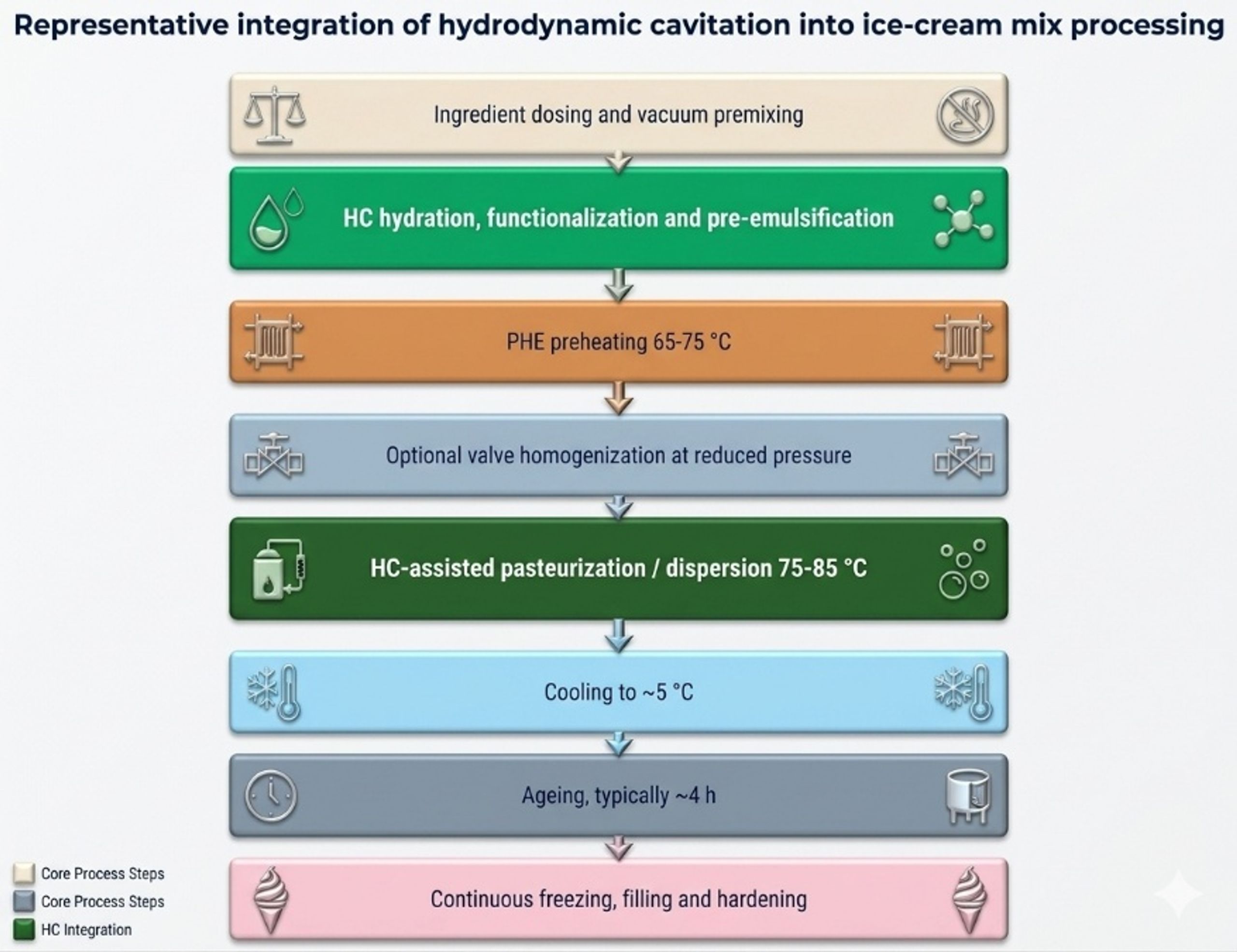
Figure 6.1. Representative integration of hydrodynamic cavitation into ice cream mix preparation. [36].
6.2 Process concept and pilot research
The SPX Flow Technology application sheet describes vacuum powder mixing and pre emulsification, cavitation assisted hydration and functionalization, preheating at approximately 65-75 °C, optional valve homogenization below about 150 bar, cavitation assisted pasteurization and dispersion at approximately 75-85 °C, cooling to 5 °C, ageing for about 4 h, and continuous freezing and hardening. The manufacturer reports comparable pre agglomeration with approximately 1 µm particles after conventional homogenization and 2-3 µm after cavitation, together with potential reduction in homogenizing pressure and longer run time between cleaning cycles [36].
An independent pilot study by Sim et al. evaluated rotor speeds of 2400-3600 rpm and flow rates of 100-200 L/h. Cavitated mixes had a larger mean particle size than the two stage homogenized control, 3.52 ± 0.28 µm compared with 0.34 ± 0.02 µm. At 3600 rpm and 100 L/h, apparent viscosity in the 30-50 s⁻¹ range was about 2.2 times that of the control, and the viscoelastic behavior changed. Melting and meltdown behavior were also altered, indicating that hydrodynamic cavitation generated a different structural state rather than simply reproducing valve homogenization [35].
These results are technically important. A larger particle scale can reflect protein fat aggregates and structured clusters rather than poor processing. The appropriate endpoint is therefore the complete frozen dessert performance: overrun, extrusion pressure, air cell distribution, fat destabilization, ice crystal size, first drip time, meltdown rate, hardness, iciness, creaminess, and storage stability.
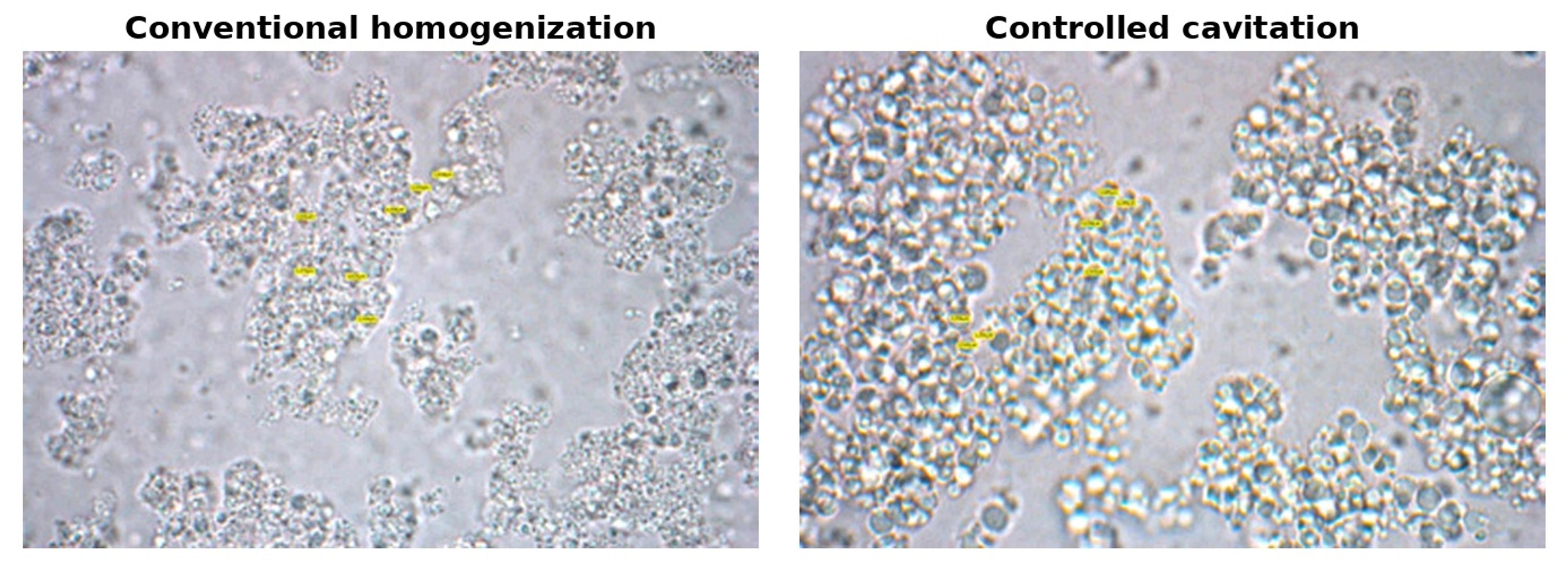
Figure 6.2. Microscopic appearance of ice cream premix after conventional homogenization and controlled cavitation. [36].
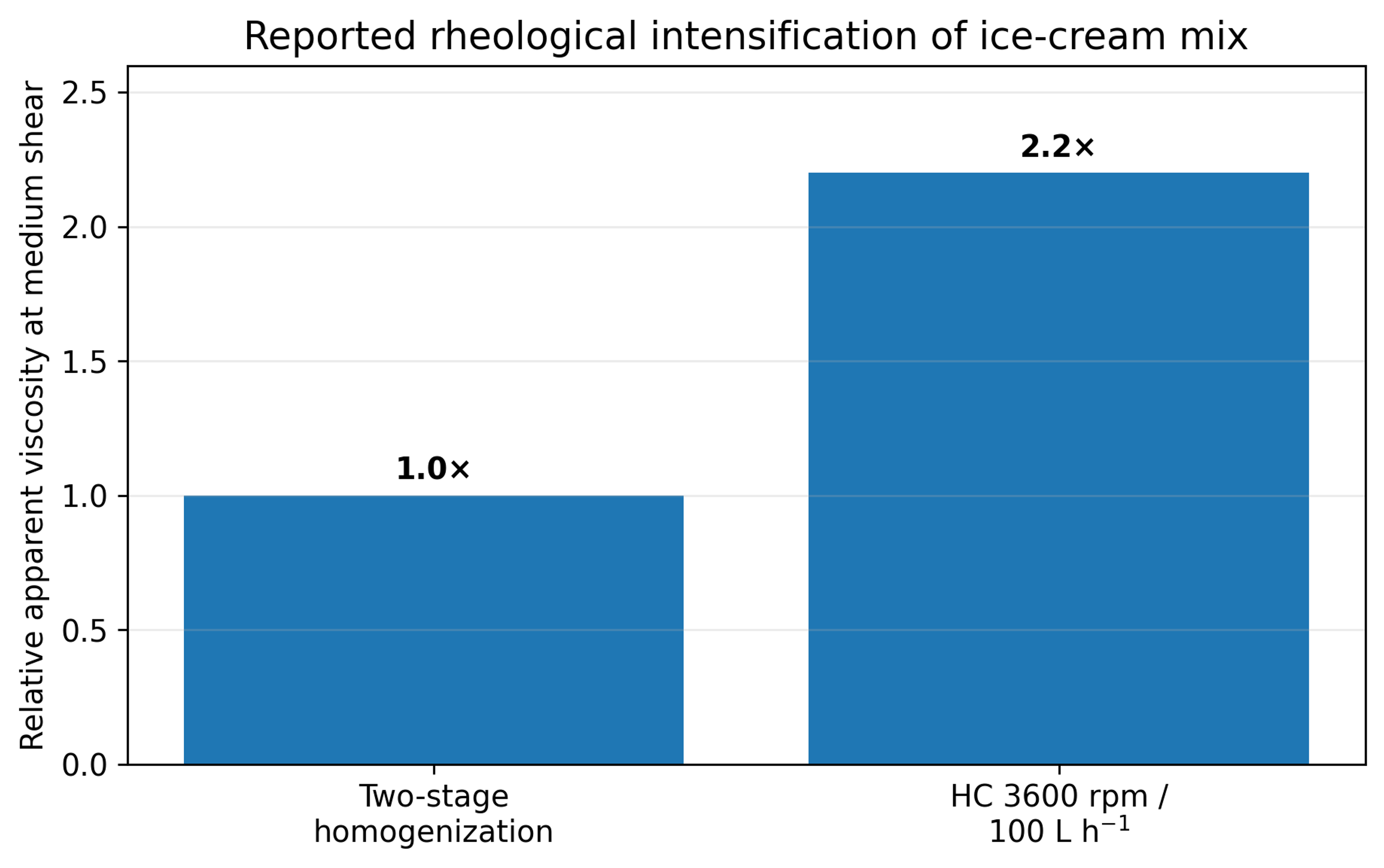
Figure 6.3. Relative apparent viscosity increase reported for a selected cavitated ice cream mix compared with two stage homogenization.. [35].
The overrun percentage is calculated using Equation (6.1):
where Overrun is the percentage volume increase caused by incorporated air, is the volume of frozen aerated product, and is the volume of unfrozen mix of the same mass basis.
6.3 Formulation and process design implications
Cavitation severity interacts strongly with stabilizer type, protein concentration, fat source, emulsifier, total solids, inlet temperature, ageing time, and freezer conditions. A reduction in stabilizer is only beneficial if meltdown resistance, heat shock stability, and sensory smoothness remain acceptable. Similarly, whey protein microparticulation can produce a creamy low fat texture, but excessive heating or shear may aggregate protein and raise viscosity beyond the capacity of the downstream freezer.
Pilot design should therefore use a response surface or sequential design of experiments. Independent variables should include rotor speed, flow, passes, inlet temperature, solids, stabilizer dose, and homogenizer pressure. Responses should include energy per kilogram, temperature rise, D10/D50/D90, d32, rheology, protein solubility, fat destabilization, overrun, first drip, complete meltdown, and sensory texture. Product temperature should be controlled independently when separating mechanical cavitation effects from heating.
Table 6.1. Critical quality attributes for cavitation assisted ice cream processing.
| Stage | Primary cavitation function | Measurements required |
|---|---|---|
| Powder incorporation | Wetting, dissolution, gum hydration, deagglomeration | Undissolved particles, viscosity development, hydration time, protein solubility |
| Pre emulsification | Fat breakup and rapid emulsifier adsorption | Droplet size distribution, free fat, emulsion stability |
| Pasteurization and heating | Bulk heating without a high temperature wall | Temperature uniformity, lethality, fouling, flavor and protein changes |
| Ageing | Controlled crystallization and interface rearrangement | Viscoelasticity, fat crystallization, partial coalescence potential |
| Freezing and aeration | Air incorporation and fat network formation | Overrun, air cell size, extrusion pressure, fat destabilization |
| Frozen storage | Resistance to heat shock and structural collapse | Ice crystal growth, hardness, iciness, meltdown, sensory acceptance |