
Technical publication
Back to publications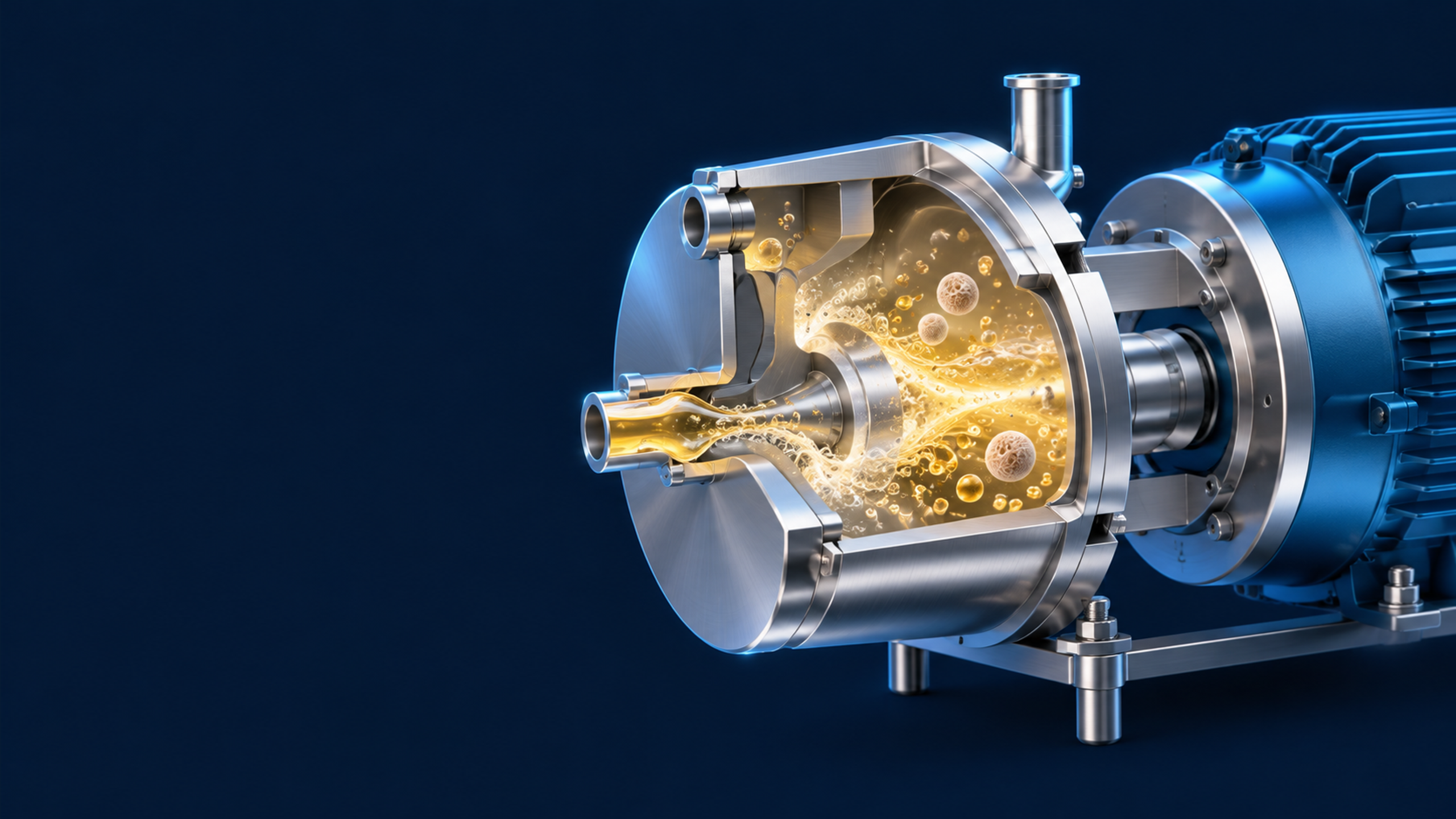
Industrial applications
Hydrodynamic Cavitation in Food and Fermentation Processing
okozyuk.com
Published
Read complete publication for whole-document Find and printing. Browser Find and native printing on this reader include only loaded content.
7 Mayonnaise and Salad Dressing
7.1 Emulsion structure and processing objectives
Mayonnaise and many salad dressings are concentrated oil in water emulsions stabilized by egg yolk components, milk or whey proteins, mustard, hydrocolloids, starch, and other surface active ingredients. Traditional mayonnaise may contain 50-80% vegetable oil, while reduced fat products replace part of the dispersed phase with structured aqueous material. Product viscosity and shelf stability depend on droplet volume fraction, droplet size distribution, interfacial coverage, continuous phase rheology, and the absence of entrained oxygen [37].
Cavitation can complete several duties in one inline step: hydrate powders, pre emulsify oil, reduce droplet size, distribute emulsifier over the newly generated interface, disperse flavor oils, and optionally introduce nitrogen for a whipped texture. The enclosed housing can limit uncontrolled air pickup, but the feed premix must be uniform and delivered at constant flow. Otherwise, transient oil rich slugs can overload the available emulsifier and cause irreversible coalescence.
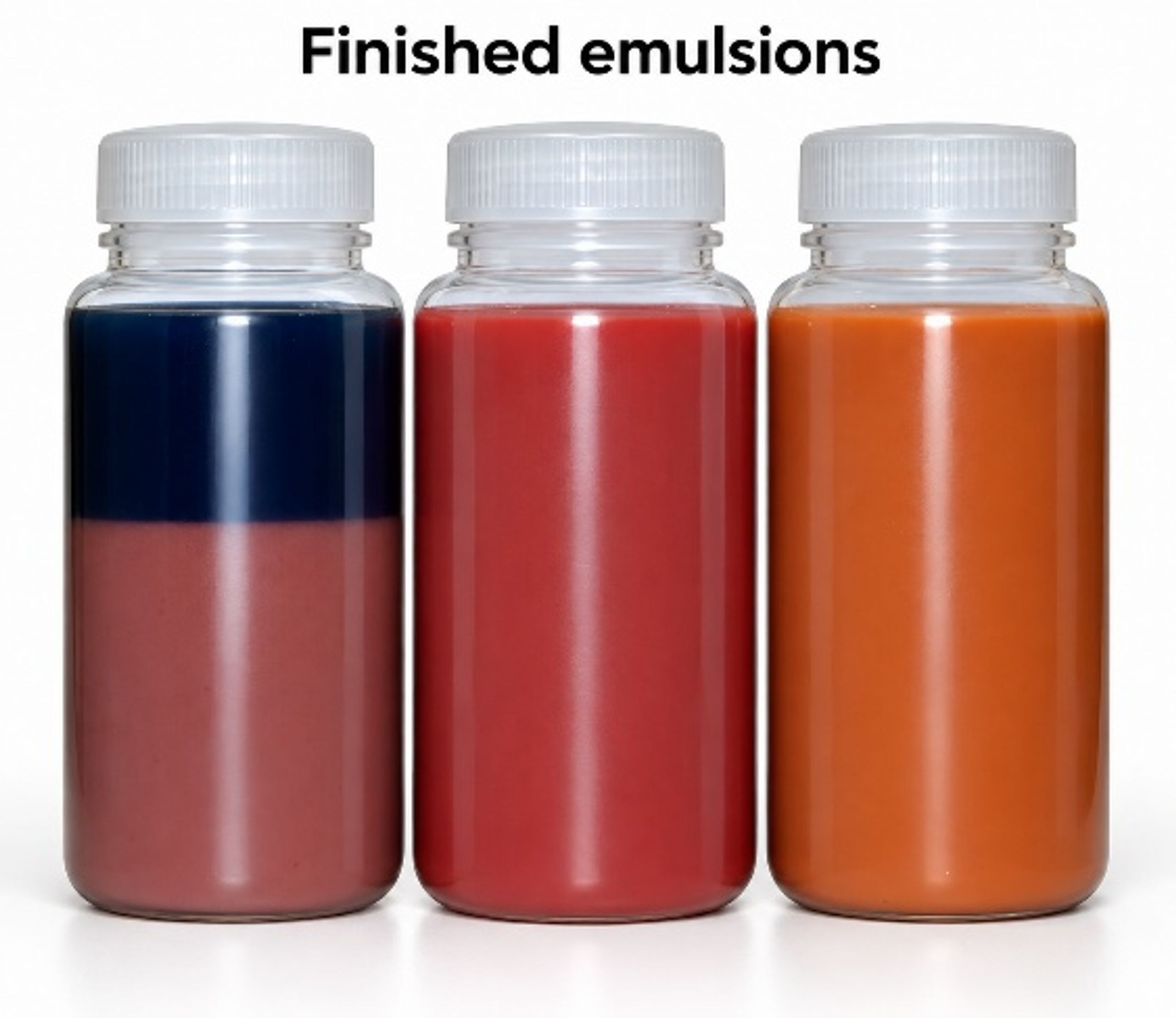
Figure 7.1. Rotor cavitator drive, cutaway of the cavitation chamber, and finished emulsion examples. [37].
7.2 Process sequence and droplet size control
A representative process begins by hydrating starch, whey protein, stabilizers, and hydrocolloids in the aqueous phase. Oil, egg yolk, vinegar, salt, sugar, mustard, spices, and flavors are metered into a batch premixer or continuous pre emulsifier. The cavitator then provides final microscopic mixing and droplet breakup. A second pass or dedicated finishing stage may adjust viscosity, gloss, color, and optional gas content [37].
The manufacturer states that droplet sizes of approximately 3-5 µm can be obtained readily and that the distribution shifts to smaller sizes as rotor frequency increases from 40 to 60 Hz. The same source proposes whey protein microparticulation for creamy mouthfeel in reduced fat formulations and nitrogen dispersion for whipped mayonnaise. These are useful process development targets, but the actual droplet distribution depends on formulation, interfacial tension, emulsifier kinetics, temperature, flow, and pass count [37].
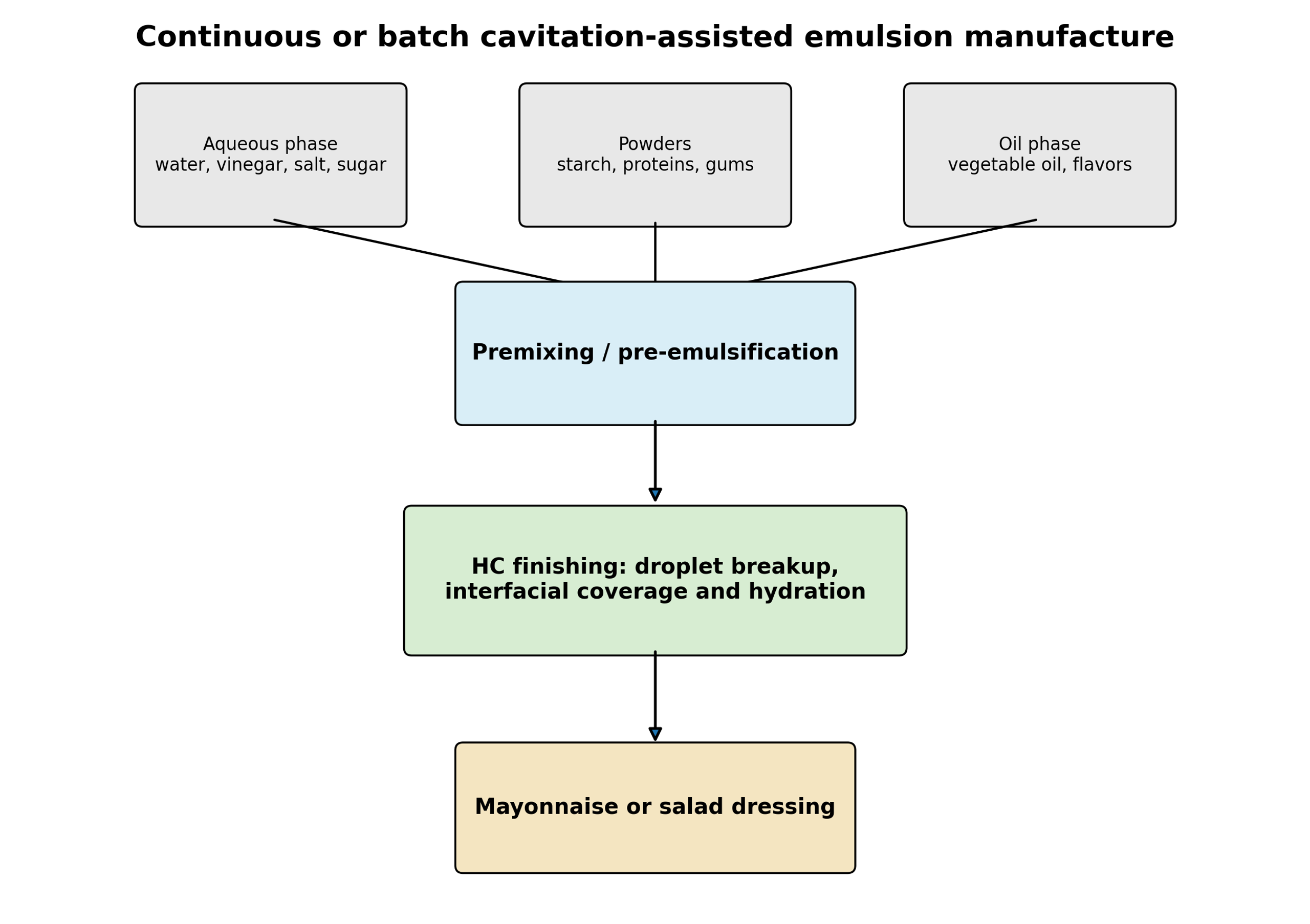
Figure 7.2. Continuous or batch process sequence for cavitation assisted mayonnaise and salad dressing manufacture. [37].
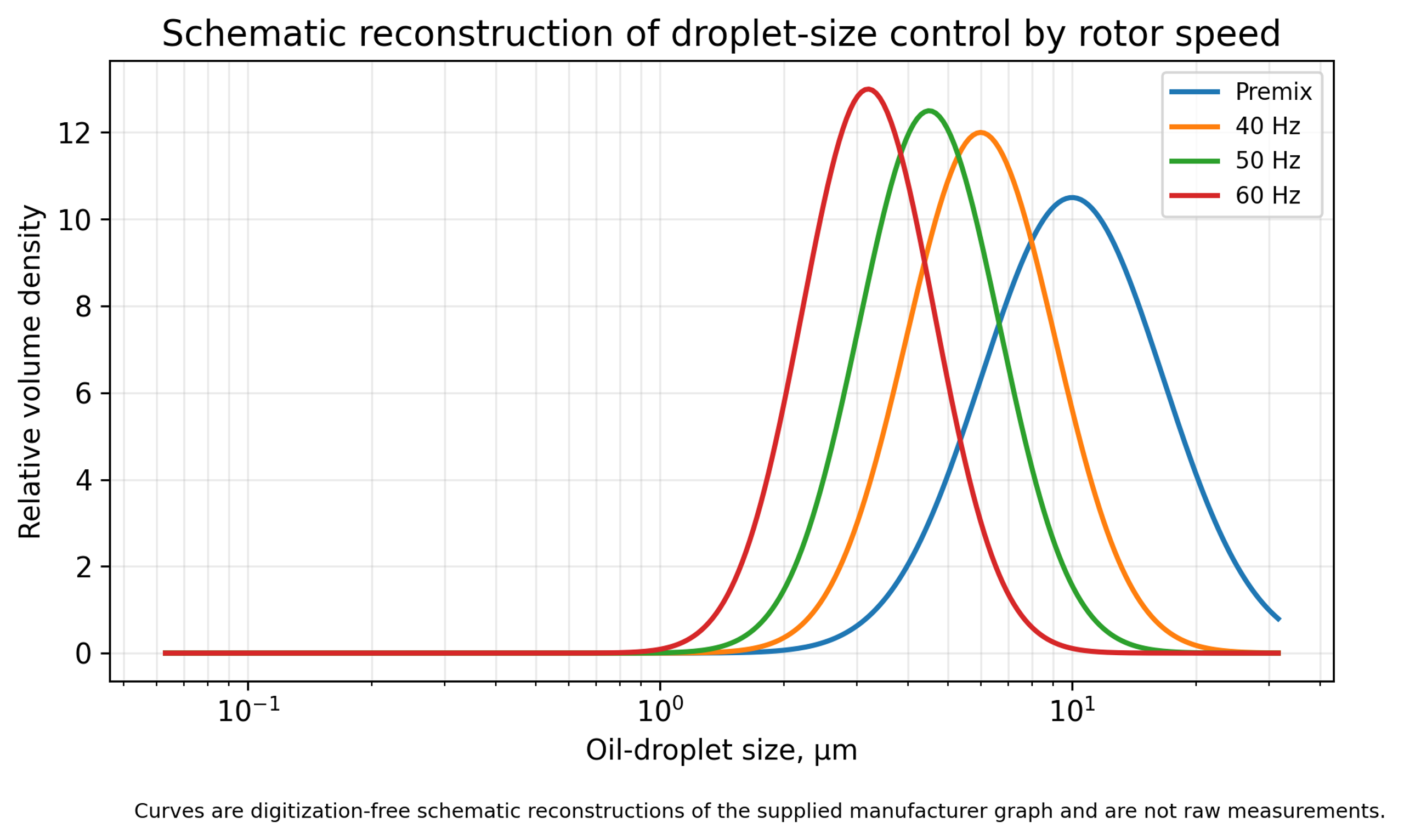
Figure 7.3. Schematic reconstruction of the SPX Flow Technology reported shift in oil droplet distribution with increasing rotor frequency. [37].
The Sauter mean diameter d32 and maximum stable dmax of the droplets can be determined from Equations (7.1) and (7.2):
where is the Sauter mean diameter, is the number of droplets in size class i, and is the representative class diameter. is proportional to dispersed phase volume divided by interfacial area and is therefore useful for emulsification energy comparisons.
where is the maximum stable droplet scale in the inertial breakup regime, C is a system dependent constant, ε is local turbulent energy dissipation rate per unit mass, γ is interfacial tension, and ρ is continuous phase density. The Hinze relation is a scaling guide rather than a complete model for concentrated mayonnaise.
7.3 Recent vortex cavitation emulsification studies
Vortex based cavitation devices provide a stationary alternative to rotor equipment. Thaker et al. compared machined and 3D printed 316L vortex diodes at about 1 L/min, and 250 kPa pressure drop. After repeated passes, both devices produced similar droplet size distributions and Sauter diameters; the study reported d32 values near the micrometer scale and little penalty from the rougher additively manufactured surface [38]. The result supports rapid fabrication of complex sanitary prototypes, although food contact qualification and cleanability of printed surfaces remain necessary.
Gode et al. examined chamber geometry, vortex stabilizers, multiple inlets, geometric scale up, and scale out using parallel devices. Multi inlet designs improved cavitation activity and droplet breakup at low pressure drop. Scale up caused a slight increase in d32 and lower energy efficiency, whereas scale out preserved the final droplet size distribution more closely. These findings favor modular parallel trains when tight emulsion quality is more important than minimum equipment count [39].
The recent vortex literature also emphasizes that final distribution is governed by cumulative energy and number of passes. A recirculating laboratory result cannot be converted directly to single pass production without sufficient active zone exposure. For mayonnaise, where viscosity increases sharply as the emulsion tightens, the pump and device must be sized for the final rather than initial rheology.
Table 7.1. Design variables for cavitation assisted mayonnaise and salad dressing.
| Variable | Effect on product | Control strategy |
|---|---|---|
| Oil volume fraction | Raises crowding, viscosity, and collision frequency | Accurate mass flow; prevent oil rich slugs |
| Emulsifier type and concentration | Controls interfacial coverage and coalescence resistance | Ensure hydration and availability before intense breakup |
| Rotor speed or pressure drop | Changes local dissipation, droplet breakup, and temperature rise | Closed loop control using power, flow, temperature, and DSD |
| Pass count or residence time | Narrows DSD until a limiting size; excessive exposure may heat or aggregate proteins | Define endpoint from DSD and viscosity, not time alone |
| Temperature | Changes viscosity, interfacial tension, protein state, and flavor volatility | Condition phases and cool as needed |
| Hydrocolloid hydration | Determines continuous phase viscosity and syneresis resistance | Hydrate before final emulsification; verify fisheye elimination |
| Particulates and spices | Can add flavor and homemade appearance but may obstruct close clearance devices | Confirm passage size and distribution without damage |
| Gas content | Affects density, oxidation, color, and whipped texture | Vacuum deaeration or controlled N2/CO2 addition |