
Technical publication
Back to publications
Industrial applications
Hydrodynamic Cavitation in Food and Fermentation Processing
okozyuk.com
Published
Read complete publication for whole-document Find and printing. Browser Find and native printing on this reader include only loaded content.
5 Egg Processing
5.1 Product sensitivity and process objectives
Liquid egg is a heat sensitive, protein rich fluid whose functionality depends on the integrity and dispersion of yolk lipoproteins, albumen proteins, and the natural emulsifying system. Pasteurization must control the relevant microorganisms without excessive coagulation, gelation, loss of foaming, or loss of emulsifying performance. Conventional plate heat exchangers are susceptible to protein fouling, which lowers heat transfer coefficient, increases pressure drop, and shortens production runs.
A rotor cavitator offers two potential advantages. First, microscopic mixing produces a more uniform whole egg dispersion before the holding tube, reducing local compositional differences. Second, conversion of shaft work to bulk heat occurs within the liquid rather than across a high temperature metal surface, reducing the hot wall driving force for fouling. These are plausible and useful engineering functions, but the supplied quantitative operating data come from a manufacturer application sheet and should be treated as manufacturer reported until independently validated [34].
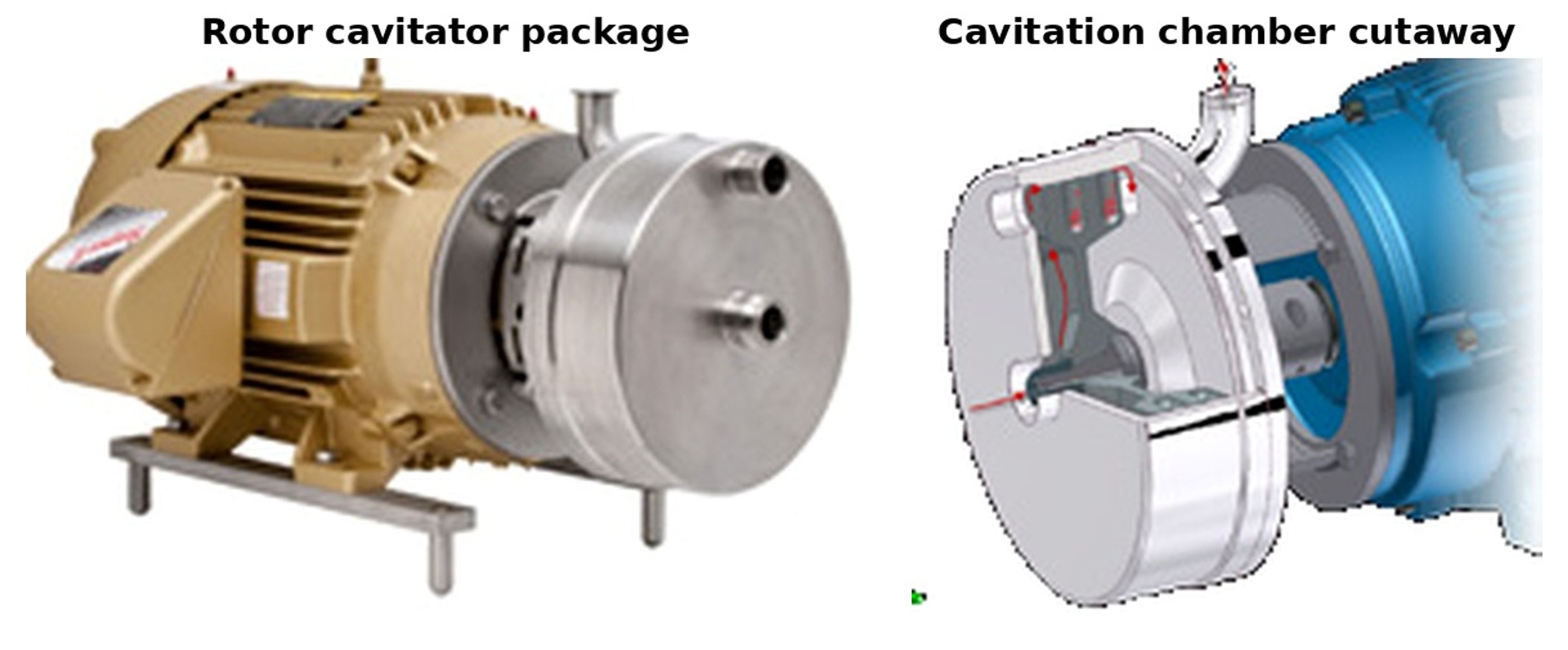
Figure 5.1. Rotor cavitator package and cutaway of the cavitation chamber used in egg processing applications. [34].
5.2 Representative hybrid homogenization and pasteurization sequence
The supplied application sheet describes a whole liquid egg stored near 3 °C, preheated in a plate heat exchanger to approximately 56-58 °C, and then passed through the rotor cavitator at about 4 bar. The cavitator raises the product temperature by roughly 10 °C to approximately 66-68 °C while homogenizing the stream. A representative holding time of 3.5 min is followed by cooling to about 3 °C and hygienic packing [34].
The manufacturer reports that the absence of a conventional heat transfer surface in the cavitator extends run time to approximately 8-12 h between cleaning cycles, about 4 h longer than a conventional process, while protecting egg functionality. The same source states that yolk and white can also be treated with egg white requiring a product specific temperature adjustment. These values define a useful pilot starting point, not a regulatory process schedule. A commercial process must validate minimum residence time, worst case temperature, target organism lethality, post process contamination control, and functional performance for each formulation [34].
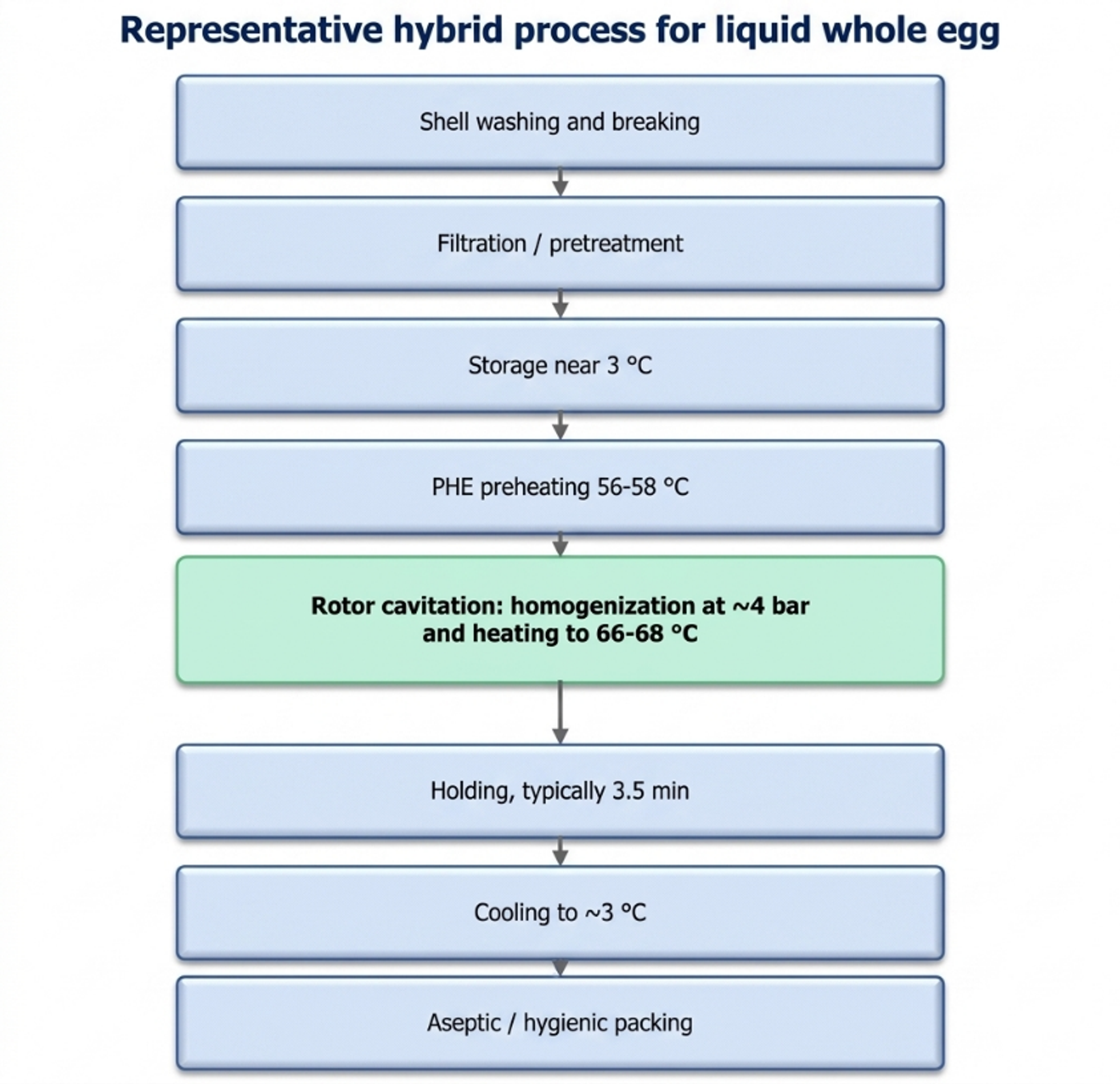
Figure 5.2. Representative hybrid process for liquid whole egg with plate preheating, cavitation assisted homogenization and heating, holding, cooling, and packing. [34].
The time equivalent to the lethal effect is calculated using Equation (5.1):
where F is equivalent lethality time at reference temperature , T(t) is the measured product temperature history, and z is the temperature change required for a tenfold change in decimal reduction time. The correct target organism and kinetic constants must be established for the specific egg product.
5.3 Fouling, function retention, and hygienic design
Fouling mitigation should be verified by direct plant measurements rather than inferred only from appearance. The relevant indicators are heat transfer coefficient, pressure drop, wall temperature, run length, deposited mass, cleaning chemical demand, rinse conductivity, and microbiological verification after cleaning. Rotor power and bulk temperature rise should also be trended because viscosity and solids content affect disc friction.
Functional quality should include whole egg viscosity, yolk emulsion stability, albumen foaming capacity and stability, gel strength, color, and sensory behavior in the intended end product. Excess cavitation can denature or aggregate proteins even when no visible coagulation occurs. The preferred operating window is therefore the lowest severity that provides uniformity and validated lethality after the holding step.
Sanitary design requires fully drainable product contact surfaces, cleanable rotor holes, appropriate elastomers, sealed bearings outside the product zone, validated clean in place velocity, and inspection for protein accumulation behind shields or near the shaft. The equipment should be integrated with divert logic, so product is not released unless both temperature and minimum holding time are met.
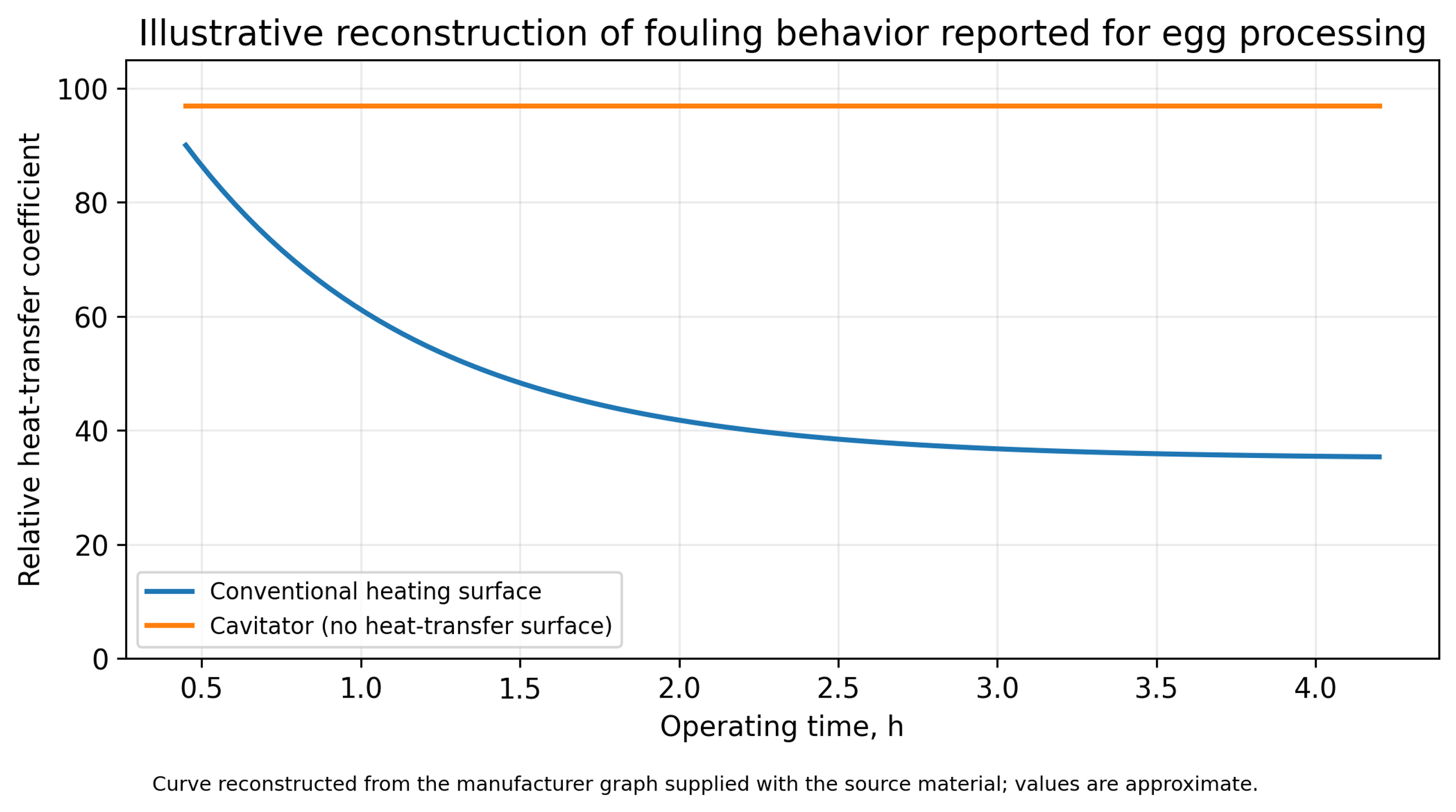
Figure 5.3. Illustrative reconstruction of the manufacturer reported difference between a conventional heating surface and a cavitator without a product contact heat transfer surface. [34].
Table 5.1. Egg processing design and validation checklist. [34].
| Item | Representative manufacturer condition | Independent validation required |
|---|---|---|
| Feed and preheat | Whole egg near 3 °C; preheat to 56-58 °C | Composition, viscosity, starting microbiology, preheater fouling |
| Cavitator | Approximately 4 bar; temperature rise to 66-68 °C | Rotor speed, flow, energy, residence time distribution, minimum outlet temperature |
| Holding | Typically, 3.5 min | Minimum residence time, target organism kinetics, and verified holding time basis |
| Cooling and packing | Cool to about 3 °C | Cooling rate, hygienic zone, package integrity, post process contamination |
| Run length | Manufacturer reports 8-12 h between CIP | Heat transfer trend, deposits, ATP or microbiological verification, cleaning repeatability |
| Product function | Manufacturer reports protected functionality | Foaming, emulsification, gelation, viscosity, color, sensory performance |