
Technical publication
Back to publications
Reactors & equipment
Hydrodynamic Cavitation in Emulsification and Homogenization
okozyuk.com
Published
Read complete publication for whole-document Find and printing. Browser Find and native printing on this reader include only loaded content.
9 Comparison with Established Emulsification Technologies
Hydrodynamic cavitation is not a universal substitute for high pressure homogenization, microfluidization, ultrasonication, rotor stator mixing, colloid milling, membrane emulsification, or low energy phase inversion. The appropriate method depends on formulation, target distribution, throughput, contamination tolerance, thermal sensitivity, cleaning requirements, and capital constraints [1,8,13,26,29,71].
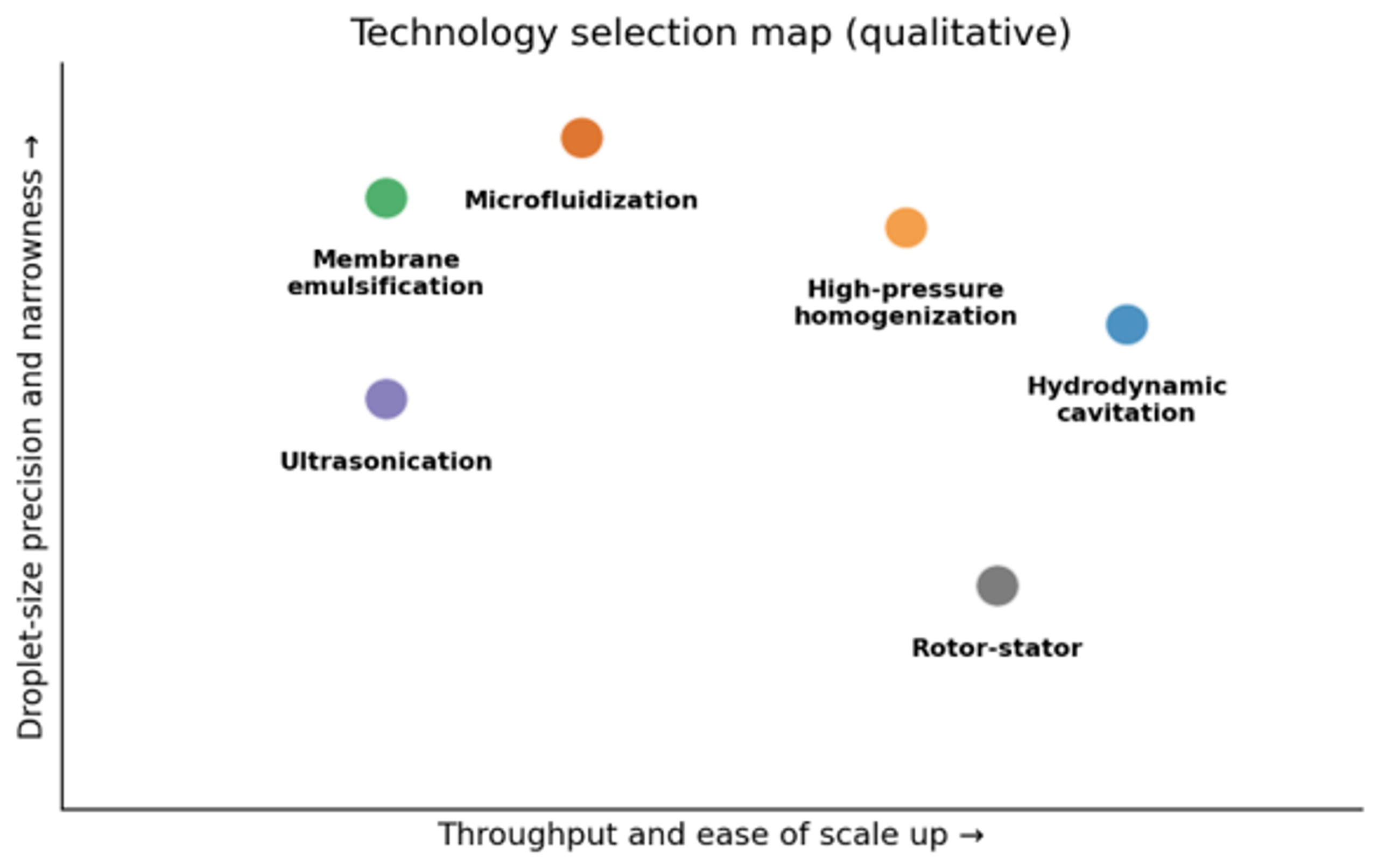
Figure 35. Qualitative selection map for emulsification technologies. Position depends on formulation and equipment scale; the diagram is intended for screening rather than specification [9].
Table 14. Critical comparison of hydrodynamic cavitation with established emulsification technologies.
| Technology | Main strengths | Main limitations | Position of hydrodynamic cavitation |
|---|---|---|---|
| High pressure homogenization | Mature, reproducible, fine droplets, validated in dairy and pharmaceuticals | High pressure, valve wear, heat, capital and maintenance | HC may produce comparable results in selected systems at lower pressure, but HPH is more standardized |
| Microfluidization | Strong extensional flow and precise interaction chambers | Very high pressure, clogging sensitivity, high capital cost | HC is generally more robust for larger passages and industrial streams |
| Ultrasonication | Effective laboratory screening and small batch nanoemulsions | Scale nonuniformity, probe erosion, noise, heat, limited penetration | HC is usually easier to scale continuously with pumps and piping |
| Rotor stator mixing | Simple, robust, excellent premixing, wide viscosity range | Often limited in submicron range; high speed and air entrainment | HC can be a polishing step or an intensified inline alternative |
| Colloid mill | Handles viscous products and provides adjustable gap | Moving surfaces, heat, wear, limited nanoscale capability | HC has no close contact grinding surfaces in static designs |
| Membrane emulsification | Narrow distributions and low shear | Low throughput, membrane fouling, pressure limitations | HC offers higher throughput but usually broader DSD |
| Phase inversion or spontaneous emulsification | Low mechanical energy for compatible formulations | Strong composition and temperature dependence, high surfactant | HC is more mechanically flexible across formulations |
| Vortex cavitation | Open passages, low pressure drop, modular continuous operation | Emerging design standards and device specific modeling | Especially promising for micron scale continuous emulsions and dense systems |
| Rotor stator cavitation | Independent speed control and combined stress mechanisms | Moving parts, seals, heat, and mechanical complexity | Useful where speed control and compact continuous processing are important |
Comparisons should be made on a common product basis: identical formulation, droplet size metric, coarse tail, throughput, pass count, hydraulic and electrical energy, temperature rise, and storage stability. Studies show that breakup morphology and useful droplet reduction depend strongly on local stress history and mixing arrangement [12,13,26,27]. Consequently, no single efficiency ratio should be transferred between devices without a controlled head to head test.
Hydrodynamic cavitation is most competitive when the process requires continuous operation, moderate to high throughput, compact equipment, simultaneous mixing and homogenization, tolerance of millimetre scale passages, and micron to submicron droplets. High pressure homogenization or microfluidization remains preferable when a tightly specified nanoscale tail has already been validated. Membrane or microchannel methods remain preferable when monodispersity is more important than capacity.
Table 15. Common failure modes and corrective actions.
| Observation | Probable cause | Diagnostic check | Corrective action |
|---|---|---|---|
| Droplet size remains coarse | Cavitation below inception; inadequate premix; high interfacial tension | Pressure profile, flow, visual or acoustic regime, premix DSD | Increase velocity within limits, improve premix, adjust emulsifier or temperature |
| Size improves then worsens at stronger cavitation | Supercavitation, gas cushioning, heating, recoalescence | Cavitation image, void fraction, outlet temperature, DSD immediately and after delay | Increase backpressure, reduce pressure drop, degas, cool, improve stabilization |
| Broad or bimodal DSD persists | Unequal exposure, bypass, too few passes, inadequate residence mixing | RTD test, branch flows, DSD bypass | Improve loop mixing, manifold balance, or active zone encounter |
| Excessive foam | Air ingress, dissolved gas release, surfactant foaming | Suction pressure, seals, tank return location | Eliminate leaks, submerge return, degas, reduce free fall and agitation |
| Rapid temperature rise | Excess recirculation, pump inefficiency, high pressure loss | Energy balance and temperature versus time | Add heat exchange, reduce passes, use scale out or single pass design |
| Oxidation or active loss | Oxygen pickup, radicals, heat, metal catalysis | Dissolved oxygen, peroxide value, assay, metal ions | Inert gas, antioxidants, lower temperature, shorter exposure, compatible materials |
| Pressure drop drifts upward | Fouling, blockage, viscosity increase | Clean water baseline, inspection, rheology | Clean, enlarge passage, revise premix or formulation sequence |
| Pressure drop drifts downward | Erosion or edge rounding | Geometry inspection and flow calibration | Replace insert, use harder material, move collapse away from wall |
| Downstream separation is poor | Emulsion is too stable or droplets too small | Centrifuge test, interfacial tension, soap or surfactant level | Add coalescence stage, reduce intensity, adjust chemistry or temperature |