
Technical publication
Back to publications
Industrial applications
Hydrodynamic Cavitation for Wastewater Processing
okozyuk.com
Published
Read complete publication for whole-document Find and printing. Browser Find and native printing on this reader include only loaded content.
1 Introduction
This article applies consistent hydraulic definitions, energy boundaries, residence time expressions, uncertainty requirements, and scale translation principles to hydrodynamic cavitation for water processing. The discussion focuses on mechanisms, process models, design variables, and acceptance criteria specific to wastewater, sludge, ballast water, and disinfection applications.
Water processing must address contaminant classes that are not reliably removed by conventional clarification and biological treatment. These include refractory organic compounds, pharmaceuticals, pesticides, dyes, solvents, pathogens, algal cells, viruses, and complex solids in waste activated sludge. Hydrodynamic cavitation (HC) is applicable because a single flow through device can generate mechanical, thermal, and chemical effects, commonly near ambient bulk temperature and without requiring an optical path through the liquid [1-8].
Cavitation is the formation, growth, oscillation, and collapse of vapor or gas vapor cavities when local liquid pressure approaches or falls below the vapor pressure. In HC equipment, the pressure trajectory is generated by the flow field. Static devices employ constrictions, Venturi passages, orifices, nozzles, vortex chambers, and bluff bodies, whereas dynamic devices use rotating surfaces, teeth, cavities, holes, or rotor stator gaps. Effective treatment depends not on cavity formation alone, but on the controlled sequence of inception, growth, transport, and collapse and on the spatial distribution of these events throughout the treated volume [3-10].
Hydrodynamic cavitation can perform several distinct process functions. It can serve as a pretreatment that increases the biodegradability of refractory material, a disintegration step that exposes intracellular and extracellular substrates, an oxidation reactor that generates or activates reactive species, a contactor that improves gas or oxidant transfer, or a disinfection step that damages microorganisms through mechanical and chemical mechanisms. These functions should be evaluated separately. A configuration optimized for cell disruption may not be optimal for oxidation of a hydrophilic pharmaceutical, and rapid disappearance of a parent compound does not necessarily imply adequate total organic carbon removal or toxicity reduction [4,5,8].
The literature considered includes foundational reviews, pilot experiments, industrial wastewater studies, sludge processing investigations, jet generated cavitation, ballast water systems, and patents. Reported values are specific to the experimental system. Valid comparison requires consistent treatment of reactor volume, pass number, pressure definition, pump efficiency, water chemistry, temperature, contaminant concentration, and analytical endpoint.
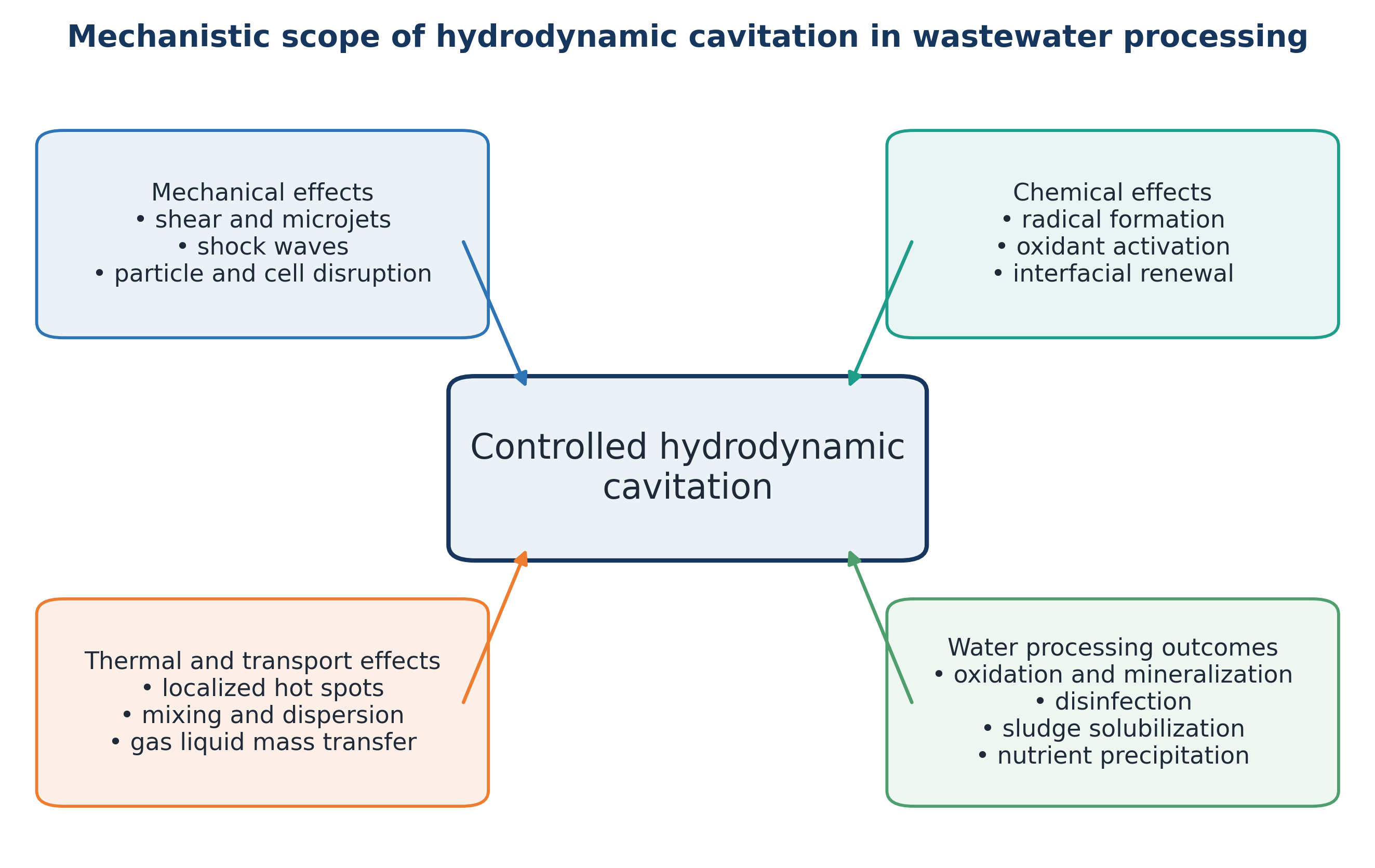
Figure 1.1. Mechanistic scope of hydrodynamic cavitation in wastewater processing [11].