
Technical publication
Back to publications
Other
Fabrication of High Performance Catalysts by Controlled Flow Cavitation
okozyuk.com
Published
Read complete publication for whole-document Find and printing. Browser Find and native printing on this reader include only loaded content.
10 Safety, Materials, Environmental, and Economic Assessment
CFC combines high pressure equipment with reactive salts, corrosive precipitants, reducing agents, fine particles, and potentially flammable or toxic solvents. Process hazard analysis must address stored hydraulic energy, line rupture, seal failure, restriction ejection, overpressure from gas evolution, pump cavitation outside the intended zone, thermal runaway during neutralization, and exposure to dry nanopowder.
Erosion has both mechanical and catalytic consequences. Trace iron, chromium, nickel, cobalt, or other alloy constituents can change catalyst activity or poison downstream processes. Wear coupons, inspection intervals, differential pressure trend analysis, and routine product metal analysis should therefore be included in qualification. Ceramic inserts or hard alloys can reduce wear but may introduce brittleness, cost, or alternative contamination risks.
Environmental assessment must use a complete process boundary. High pressure pumping consumes electricity, whereas improved yield, shorter reaction time, reduced wash water, lower drying load, or reduced calcination duty can save energy. Any claimed energy advantage is valid only when product quality and yield are equivalent. The 2026 ultrasonic jet study illustrates the need to account explicitly for the energy of additional fields [11].
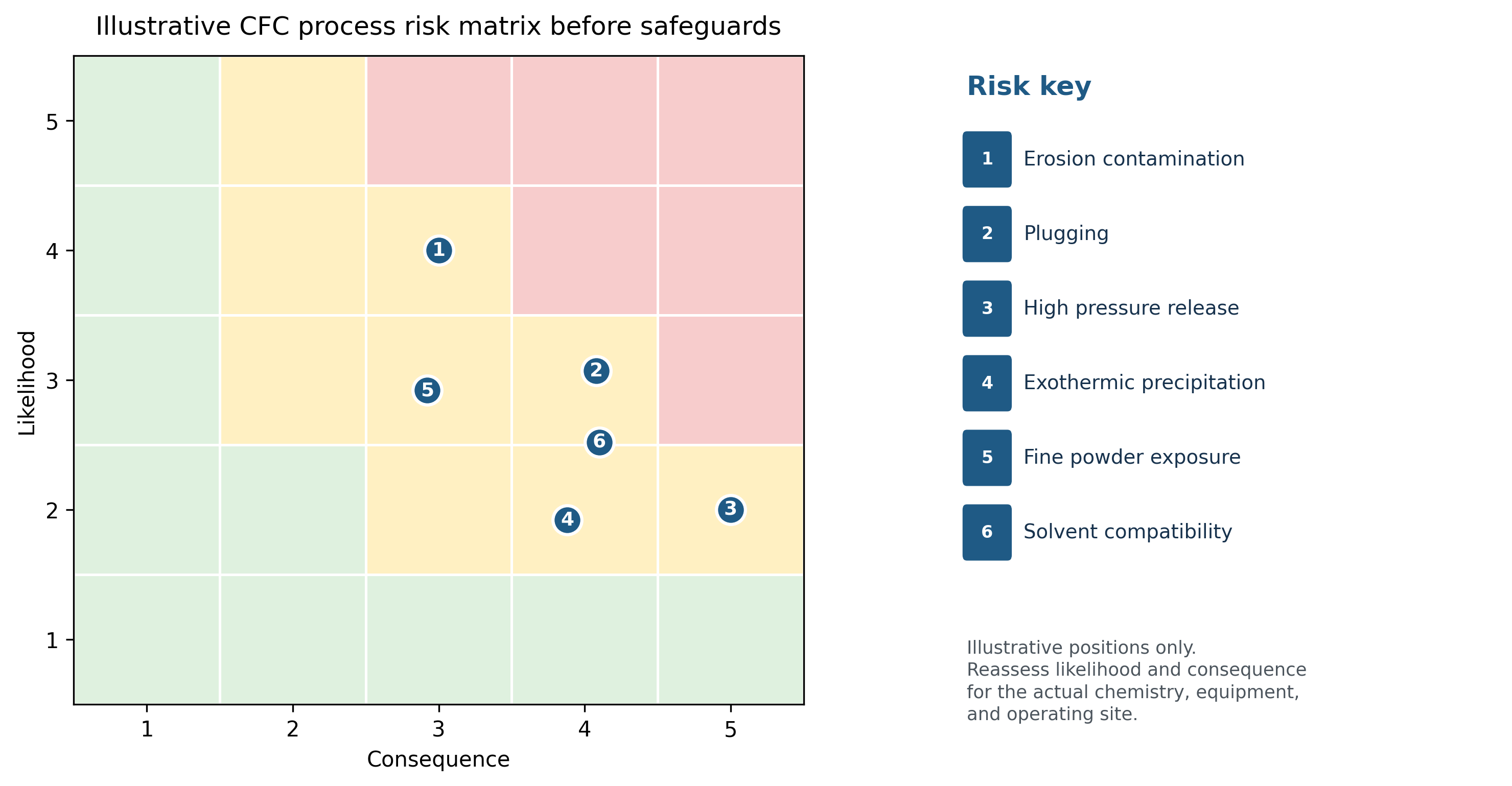
Figure 10.1. Illustrative cavitation process risk matrix before safeguards. The position of each item must be reassessed for the actual chemistry, equipment, and operating site. [29].
Table 10.1. Principal hazards and safeguards for cavitation catalyst fabrication
| Hazard | Potential consequence | Engineering safeguards | Verification |
|---|---|---|---|
| High pressure release | Injection injury, chemical exposure, equipment damage | Rated components, shielding, relief, isolation, remote operation | Pressure test, relief certification, inspection |
| Restriction plugging | Rapid pressure rise, unstable flow, batch loss | Feed filtration, differential pressure alarm, bypass or controlled shutdown | Challenge test and cleaning validation |
| Erosion and contamination | Wall thinning and altered catalyst chemistry | Wear resistant materials, velocity limits, replaceable inserts | Thickness inspection and ICP wear metal trend |
| Reactive precipitation | Heat release, gas evolution, local high pH or low pH | Metered feed, calorimetry, temperature interlock, venting | Reaction hazard assessment |
| Reducing agent or solvent | Fire, toxicity, decomposition, incompatible materials | Closed handling, ventilation, compatible seals, inerting where required | Compatibility and exposure monitoring |
| Fine powder | Inhalation, dust explosion, product loss | Wet handling, contained drying, dust collection, grounding | Industrial hygiene and dust hazard test |
| Pump heating and loss of flow | Decomposition, vapor lock, seal damage | Minimum flow interlock, heat exchanger, temperature trip | Functional trip test |
| Cleaning and changeover | Cross contamination and incompatible residues | Validated sequence, drainability, material segregation | Swab, rinse, and analytical verification |