
Technical publication
Back to publications
Industrial applications
Design and Operating Principles of Rotor-Stator Mixers
okozyuk.com
Published
Read complete publication for whole-document Find and printing. Browser Find and native printing on this reader include only loaded content.
1. Introduction
Rotor-stator mixers are widely used in the chemical, food, pharmaceutical, and biotechnology industries for wetting difficult powders, dissolving polymers, dispersing pigments, breaking up particle agglomerates, forming emulsions, reducing the size of soft solid inclusions, and intensifying interfacial mass transfer. The rapid relative motion between a rotating element (the rotor) and a stationary structure (the stator) produces a sequence of hydrodynamic effects involving flow acceleration, intense fluid deformation, and high-velocity discharge through flow passages. In fractions of a second, material entering the mixing head experiences combined viscous shear, extensional deformation, impacts involving blade surfaces, high frequency pressure fluctuations, and local turbulent stresses. The analytical approach adopted here distinguishes local processing intensity from global volumetric transport, a distinction supported by experimental and computational studies [1, 2, 3].
Technical publications and commercial literature use the terms high-shear mixer, homogenizer, disperser, emulsifier, shear pump, and rotor-pulsation apparatus. These categories overlap but are not identical. For engineering design, classification by process function and physical operating mechanism is more reliable than marketing terminology. Equipment specifications should explicitly state the flow path, number of consecutive active zones, rotor-stator geometry, clearance, operating mode (batch or inline), and pressure boundary conditions. In this article, rotor-stator mixer denotes the broad family of machines, while rotor-pulsation apparatus refers specifically to designs in which periodic opening and obstruction of flow channels is a dominant mechanism [4, 5, 6, 7].
Four fundamental hydrodynamic mechanisms should be considered separately when describing the processing of heterogeneous media:
-
Viscous deformation: Results from high velocity gradients and extensional strain in gaps containing liquids and deformable phases.
-
Turbulent dissipation: Develops in unsteady wakes, separated flows, shear layers, and high velocity jets.
-
Periodic pressure pulsations: Arise from steady and unsteady interactions of moving rotor elements with stator openings and blades and can occur even in a homogeneous single-phase liquid.
-
Vapor cavitation: Requires local static pressure to fall to the liquid vapor pressure, followed by pressure recovery and collapse of the vapor cavities formed.
The release or expansion of dissolved gas also depends on pressure history but is not equivalent to vapor cavitation. The simultaneous presence of several physical mechanisms in a mixing head does not, by itself, demonstrate that each contributes substantially to the transformation of a particular product.
Table 1.1. Terminology used in this article
| Term | Engineering meaning |
|---|---|
| Rotor | Rotating working element with blades, teeth, rings, pins, cavities, slots, or open pumping vanes. |
| Stator | Stationary element around or opposite the rotor; includes openings, edges, restrictions, and surfaces where pressure recovers. |
| Clearance | Minimum design distance between moving and stationary surfaces. The effective hydrodynamic gap may differ from the nominal mechanical clearance. |
| Active zone | Limited region where deformation, pressure pulsations, or energy dissipation are concentrated. |
| Stage | A distinct rotor-stator interaction zone. Two or more such zones are arranged consecutively in a multistage mixer. |
| Pass | One traversal through the inline mixing head. Under recirculation, mean pass count indicates average treatment but does not establish identical exposure histories for all fluid elements. |
| Rotor-pulsation apparatus | Rotor-stator machine in which periodic alignment and misalignment of passages modulate the flow area and pressure. |
| Rotational cavitation reactor | Rotating device designed to create low-pressure cavities or cavitating wakes in openings, grooves, around pins, or within gaps. |
The distinction between dispersive action, which locally disrupts structures, and distributive action, which promotes bulk circulation, is fundamental when processing heterogeneous systems. A mixing head may break droplets or agglomerates efficiently during a single pass yet exchange too little material with the remainder of the process tank. Conversely, high volumetric throughput may produce rapid macroscopic uniformity without reaching the local stresses required for structural breakup.
In their computational investigation of molten metal conditioning, Lebon and colleagues found a pronounced, geometry dependent compromise between local agglomerate disruption in the active region and redistribution of material throughout the surrounding volume. This finding further supports the distinction between processing intensity and mass transport but cannot be treated as a universal calibration for aqueous emulsions [8].
The present analysis distinguishes fundamental physical and mathematical models, manufacturer technical information, and independently reported experimental or patent results.
-
Industrial design examples are drawn from official manufacturer documentation.
-
Numerical examples and sensitivity curves are computational illustrations only.
-
Manufacturer promotional claims, patent test data, and academic studies are not treated as equivalent forms of evidence.
-
Schematic representations illustrate fundamental functional principles; they are neither production drawings nor validated velocity fields nor exact drawings of particular commercial models.
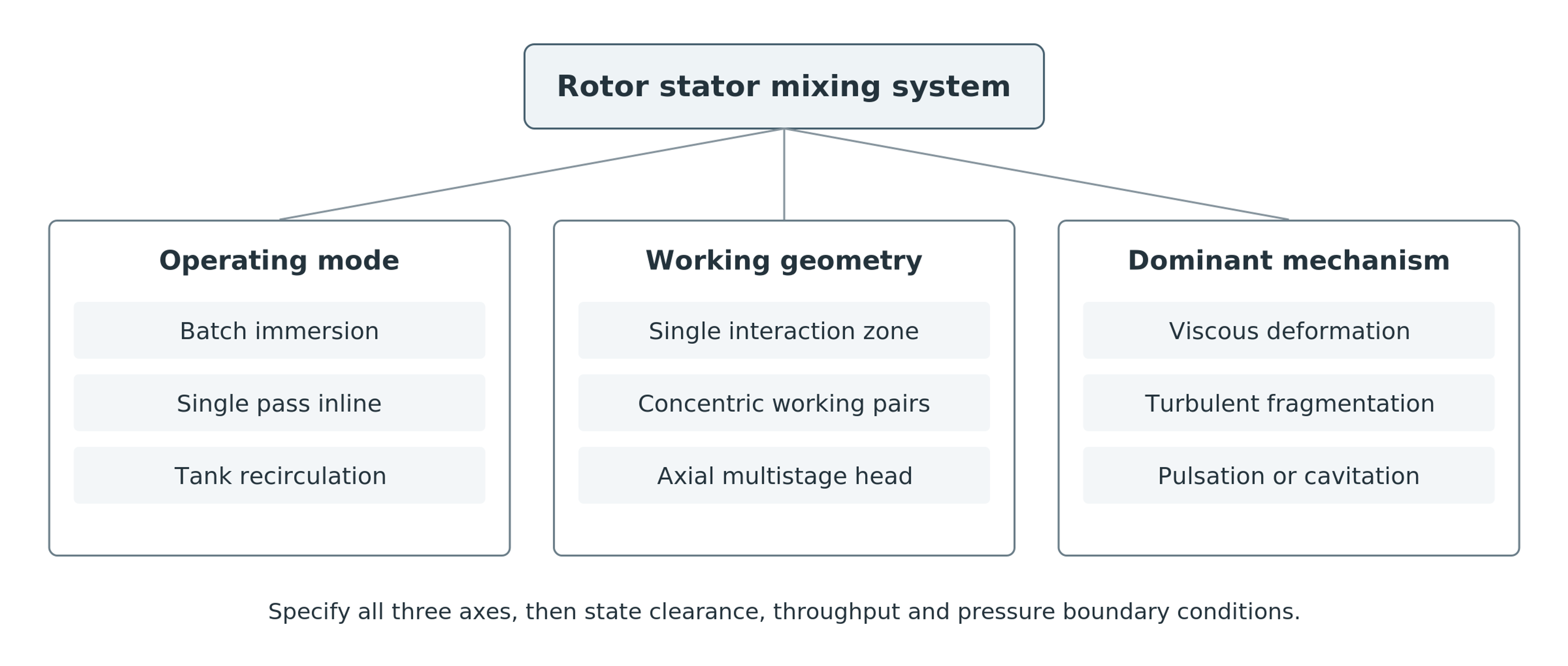
Figure 1.1. Functional classification of rotor-stator systems by operating mode, working geometry, and dominant mechanism. Original explanatory diagram based on source material [1].