
Technical publication
Back to publications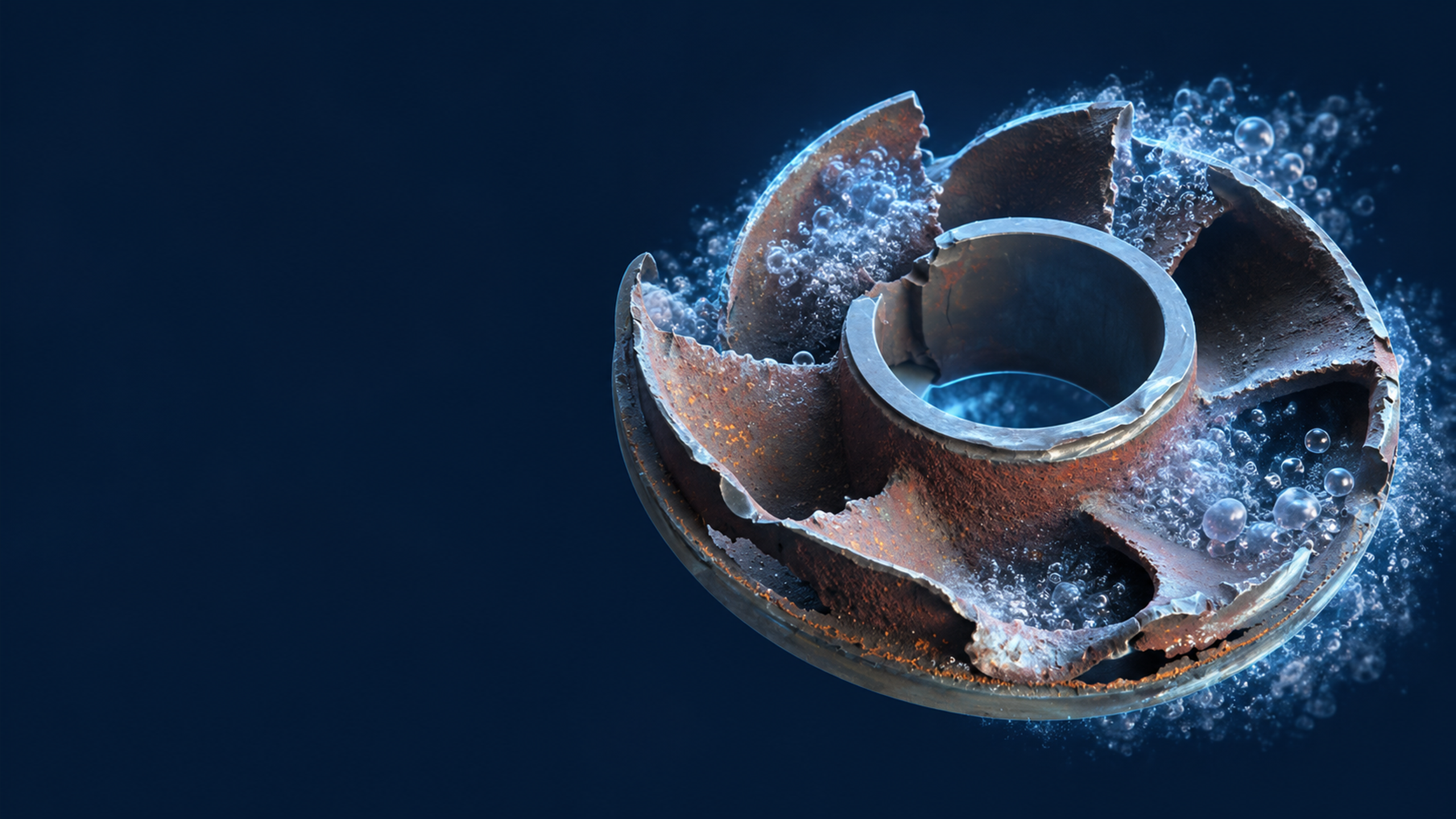
Reactors & equipment
Cavitation in Hydraulic Machinery, Valves, Piping, and Marine Systems
okozyuk.com
Published
Read complete publication for whole-document Find and printing. Browser Find and native printing on this reader include only loaded content.
5 Negative Effects and Failure Mechanisms
5.1 Performance Degradation
Vapor occupies volume that would otherwise transport liquid and alters momentum transfer. In pumps, cavitation can reduce head, capacity, efficiency, and stability. In valves, it can limit flow, modify control gain, and increase actuator demand. On propellers and hydrofoils, it can alter lift, thrust, torque, and control force. Large cavities may obstruct passages, create rotating asymmetry, and generate abrupt load changes [1,4,6,9].
5.2 Noise, Vibration, and Pressure Pulsation
Individual bubble collapse produces high frequency content, whereas cloud shedding and blade interactions create lower frequency modulation. The resulting fluid forces are transmitted through casings, pipes, shafts, foundations, and hull structures. A small cavity may be acoustically prominent without producing measurable erosion, while collapse remote from the inception site can damage a surface that appears hydraulically benign. Frequency content should therefore be interpreted in relation to machinery orders, blade passing frequency, structural resonances, and transmission paths [4,15].
5.3 Erosion, Corrosion, and Fatigue
Cavitation erosion develops through repeated localized liquid impact and shock loading that produce microscopic plastic deformation, work hardening, cracking, grain removal, and eventual pit coalescence. Material loss may include an incubation period, an accelerating stage, and a later change in rate as surface geometry and residual stress evolve. Corrosion can remove or weaken protective films between impacts, while cavitation removes corrosion products and exposes fresh metal. The combined mechanical and electrochemical loss may exceed the contribution of either process acting alone [4,9,16,17].
Mean depth of erosion rate (MDER) is commonly reported according to Eq. (10), where delta V is volume loss, delta m is mass loss, rho_s is solid density, A is exposed area, and delta t is the reporting interval. Vibratory apparatus and cavitating liquid jet methods provide comparative material data, but direct material ranking can vary with amplitude, liquid properties, temperature, specimen geometry, and exposure regime [16,17].
Table 4. Negative effects and representative failure pathways.
| Effect | Immediate mechanism | Potential consequence | Engineering evidence |
|---|---|---|---|
| Head, thrust, or control loss | Vapor blockage and altered pressure distribution. | Reduced capacity, unstable control, overspeed risk in coupled systems. | Performance curve shift, flow limitation, transient logs. |
| Noise | Bubble collapse, cloud shedding, vortex oscillation. | Nuisance, detectability, regulatory or comfort issue. | Operating condition correlation and characteristic spectral pattern. |
| Vibration and pulsation | Unsteady fluid force and asymmetric vapor. | Bearing load, piping fatigue, fastener loosening, structural resonance. | Pressure and vibration trends correlated with operating state. |
| Erosion | Microjets, shock waves, and repeated localized strain. | Loss of blade or trim profile, leakage, perforation, debris. | Pit morphology, mass or volume loss, replica or 3D scan. |
| Corrosion acceleration | Film removal and enhanced mass transfer. | Rapid loss in aggressive liquid. | Chemistry, potential, deposits, pit chemistry, material comparison. |
| Thermal and process effects | Two phase volume, local heating or cooling, gas release. | Temperature excursions, degassing, altered reaction or product quality. | Temperature, dissolved gas, composition, residence time. |
| Secondary mechanical failure | Imbalance, hydraulic instability, cyclic load. | Seal, bearing, shaft, weld, or support failure. | Alignment, orbit, shaft current, crack examination, fatigue assessment. |
5.4 Why Visible Cavitation Does Not Equal Damage
Visible cavity size does not directly determine erosion severity. Erosion requires collapse energy to be delivered sufficiently close to a susceptible surface and repeated often enough to accumulate damage. A large attached cavity may collapse well downstream and cause little local erosion, whereas a smaller cloud that repeatedly collapses near a blade trailing edge can be highly erosive. Dissolved or entrained gas can increase apparent cavity volume while cushioning collapse. Material hardness alone is not a universal predictor of resistance because strain rate response, toughness, phase stability, residual stress, corrosion resistance, and coating adhesion also influence damage [4,9,17].