
Technical publication
Back to publications
Reactors & equipment
Cavitation Driven Exfoliation of Graphene and Two Dimensional Materials
okozyuk.com
Published
Read complete publication for whole-document Find and printing. Browser Find and native printing on this reader include only loaded content.
2 Scope, Terminology, and Product Classes
A production route should begin with a written material specification rather than with the unrestricted goal of making graphene. The specification should define the intended product form, such as powder, concentrated paste, aqueous dispersion, organic dispersion, polymer masterbatch, conductive ink, or directly compounded composite. It should also define acceptable distributions of layer number, thickness, lateral size, oxygen content, trace metal content, residual stabilizer, moisture, ash, and agglomerate size. ISO/TS 9651:2025 provides a classification framework intended to improve consistency in commercial descriptions [6].
Table 2.1. Working terminology for graphene related products used in this article [3-6].
| Term | Practical description | Critical measurements | Typical processing relevance |
|---|---|---|---|
| Graphene | A single carbon layer in a hexagonal lattice. | AFM or TEM thickness, Raman 2D band, defects, contamination. | Research and high value electronic or sensing applications. |
| Bilayer graphene | Two well defined graphene layers. | Layer count, stacking, lateral size, Raman peak shape. | Electronic, optical, and model material studies. |
| Few layer graphene | A small number of graphene layers, commonly treated as three to ten in industrial discussion. | Thickness distribution, Raman response, edge and basal plane defects. | Inks, composites, coatings, energy storage, and thermal products. |
| Graphene nanoplatelets | Platelet shaped graphene related particles with nanometre scale thickness and much larger lateral dimensions. | Thickness, aspect ratio, specific surface area, oxygen, ash, residual graphite. | High volume composite, construction, lubricant, and barrier applications. |
| Graphene oxide | Oxidized graphene related sheets with oxygen containing functionality. | Oxygen to carbon ratio, functional groups, layer size, residual salts and metals. | Water dispersions, membranes, functional materials. It is not equivalent to pristine graphene. |
| Reduced graphene oxide | Partly deoxygenated graphene oxide. | Residual oxygen, lattice disorder, conductivity, impurity content. | Conductive and electrochemical products where perfect lattice restoration is not required. |
| Graphite nanosheets or expanded graphite | Thin graphitic particles that remain thicker than few layer graphene. | Thickness, expansion ratio, particle size distribution, accessible surface area. | Useful intermediate or final additive when full exfoliation is unnecessary. |
Note. The exact product designation should be linked to measured ranges and the intended application. A single average value can conceal a broad distribution that is commercially and technically important.
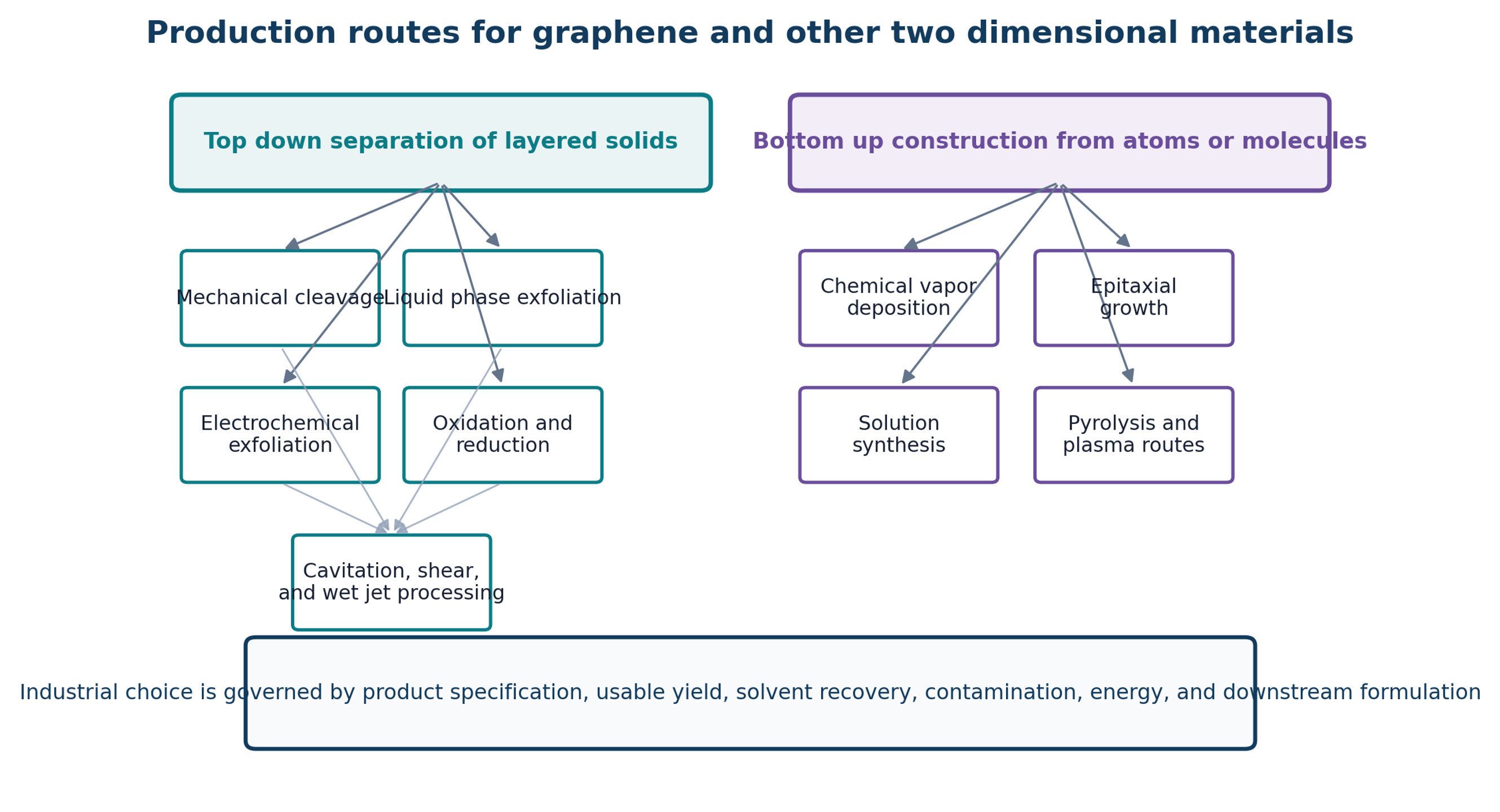
Figure 2.1. Major top down and bottom up routes for graphene and other two dimensional materials. Cavitation belongs to top down liquid processing and frequently operates together with shear, collision, pressure release, and classification [37].