
Technical publication
Back to publications
Reactors & equipment
Cavitation Driven Exfoliation of Graphene and Two Dimensional Materials
okozyuk.com
Published
Read complete publication for whole-document Find and printing. Browser Find and native printing on this reader include only loaded content.
1 Introduction
This article establishes a common engineering framework for hydraulic definitions, energy boundaries, residence time, uncertainty, and scale translation, and then applies that framework to cavitation driven exfoliation of graphene and related two dimensional materials.
The isolation of graphene demonstrated that a stable sheet only one atom thick can be separated from a bulk layered crystal while retaining exceptional electronic, thermal, optical, and mechanical properties [1]. This achievement also defined a manufacturing challenge. Methods that produce ideal flakes for laboratory study do not necessarily provide the mass throughput, consistency, cost, or formulation behavior required for industrial use. Graphene manufacturing therefore spans a broad product range, from isolated monolayers to few layer graphene, graphene nanoplatelets, expanded graphite, functionalized graphene related materials, and application specific masterbatches.
The term graphene must be used precisely. ISO terminology distinguishes graphene from bilayer graphene, few layer materials, graphene nanoplatelets, graphene oxide, reduced graphene oxide, and other two dimensional materials [3]. These distinctions are technically significant because layer number, flake thickness, lateral dimension, disorder, surface chemistry, impurity content, aggregation state, and specific surface area determine suitability for inks, polymer composites, cement, lubricants, thermal interfaces, battery electrodes, catalyst supports, membranes, and sensors. Structural characterization therefore treats thickness, lateral size, disorder, layer alignment, and specific surface area as separate measurands [4]. Chemical characterization additionally includes elemental composition, oxygen to carbon ratio, trace metals, and functional group analysis [5].
Liquid phase exfoliation is attractive because a layered solid can be separated in a liquid without necessarily requiring strong oxidation. The liquid wets newly created surfaces, transmits mechanical stress, suppresses direct particle contact, and can serve as the final formulation medium. Cavitation based exfoliation is one branch of this approach. Vapor or gas cavities form, grow, and collapse, generating pressure pulses, shock waves, microjets, turbulent shear, particle collisions, and rapid pressure release. These events can overcome interlayer attraction and generate nanosheets, but they can also cut flakes, create edge defects, damage basal planes, erode equipment, heat the liquid, and degrade stabilizers. Process design must therefore balance delamination against structural damage [7-13,17].
Graphene is used as the principal case study because the cavitation literature is most extensive for this material. The same engineering framework is then extended to hexagonal boron nitride, molybdenum disulfide, tungsten disulfide, black phosphorus, layered oxides, MXenes, and layered silicates. The objective is not to identify a universally superior reactor, but to establish a framework for selecting, measuring, scaling, and controlling a process against a defined product specification.
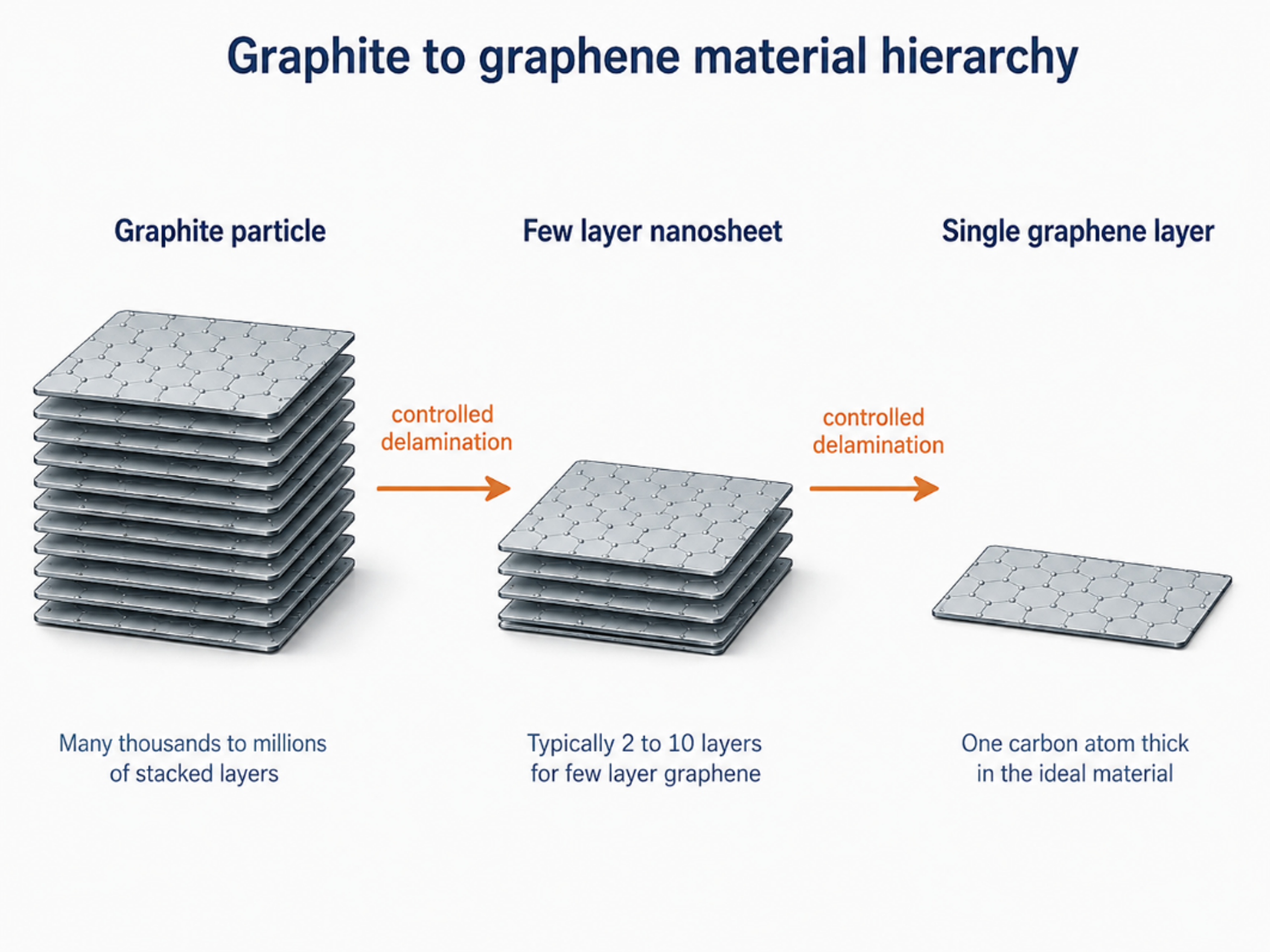
Figure 1.1. Hierarchy from a graphite particle to a few layer nanosheet and an ideal single graphene layer. Industrial powders normally contain a distribution rather than one uniform layer count [37].