
Technical publication
Back to publications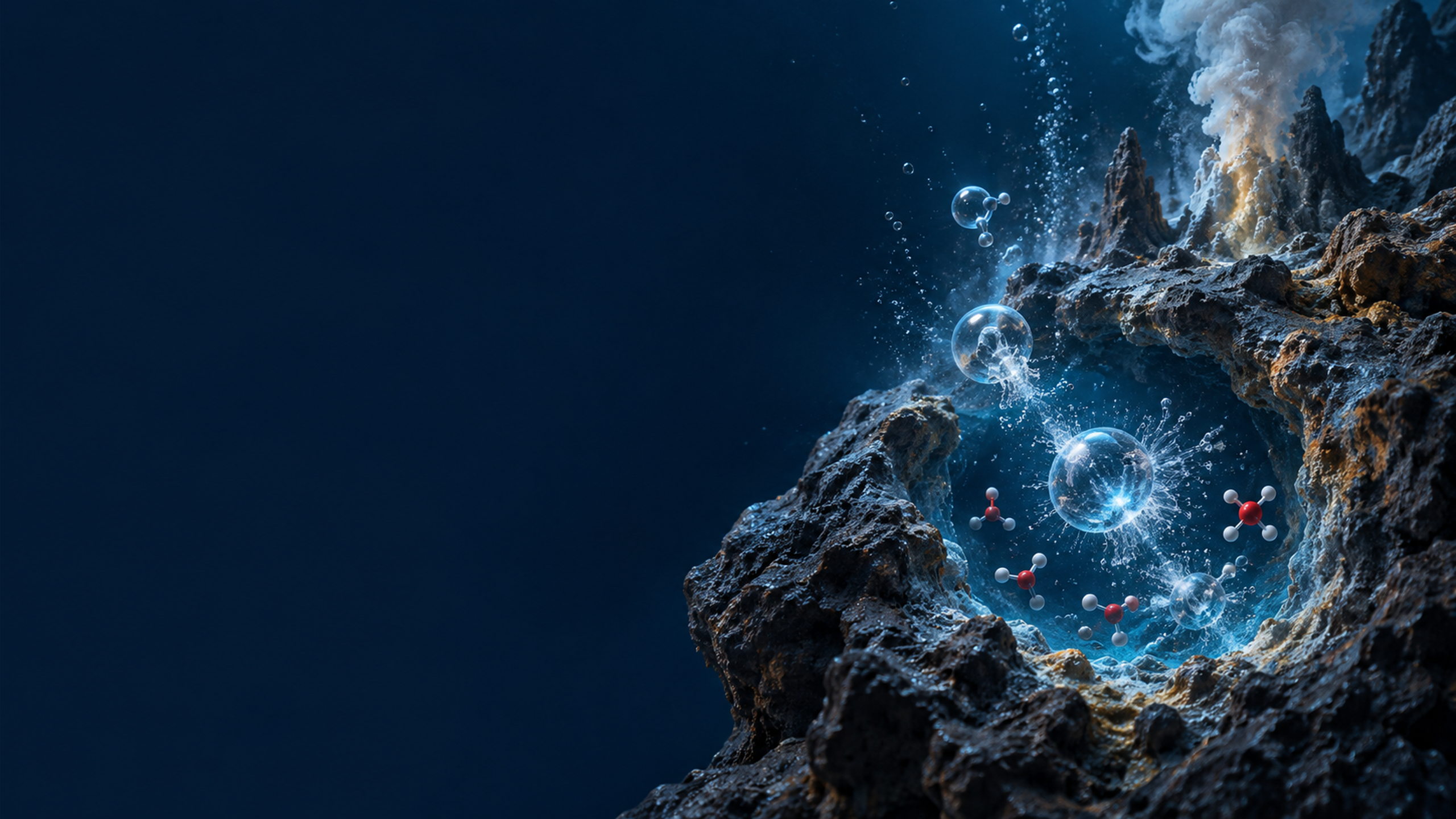
Reactors & equipment
The Rise of Life on Earth: Cavitation in Nature
okozyuk.com
Published
Read complete publication for whole-document Find and printing. Browser Find and native printing on this reader include only loaded content.
Abstract
The phenomenon of cavitation has been known in science and technology for more than a hundred years. It was first recognized as an important hydrodynamic phenomenon in connection with high speed marine propulsion, including early observations associated with British destroyers in the late nineteenth century. Osborne Reynolds and later researchers helped establish cavitation as a serious problem in ship propellers, pumps, and turbines [1,2].
Probability and Geological Time
What is the probability that one cavitation bubble became the reactor in which the first simple amino acid was synthesized?
A precise numerical answer cannot currently be given. The early Earth’s exact atmospheric composition, ocean chemistry, gas concentrations, mineral environments, temperature ranges, and cavitation rates are not known with enough certainty. In addition, a single cavitation bubble exists for only a brief moment.
However, the probability becomes more meaningful when considered over planetary time. If cavitation occurred millions or billions of times per second across early Earth environments, and if such activity continued for millions of years, then the number of natural experiments would have been enormous.
Most bubbles would have produced no lasting product. Some would have destroyed molecules rather than create them. But some could have formed reactive intermediates or simple organic compounds. Over time, these compounds could have accumulated, reacted further, or entered other prebiotic environments.
Thus, the most plausible hypothesis is not that life began in one unique bubble. Rather, cavitation may have been part of a vast natural chemical network that slowly increased molecular complexity on early Earth.