
Technical publication
Back to publications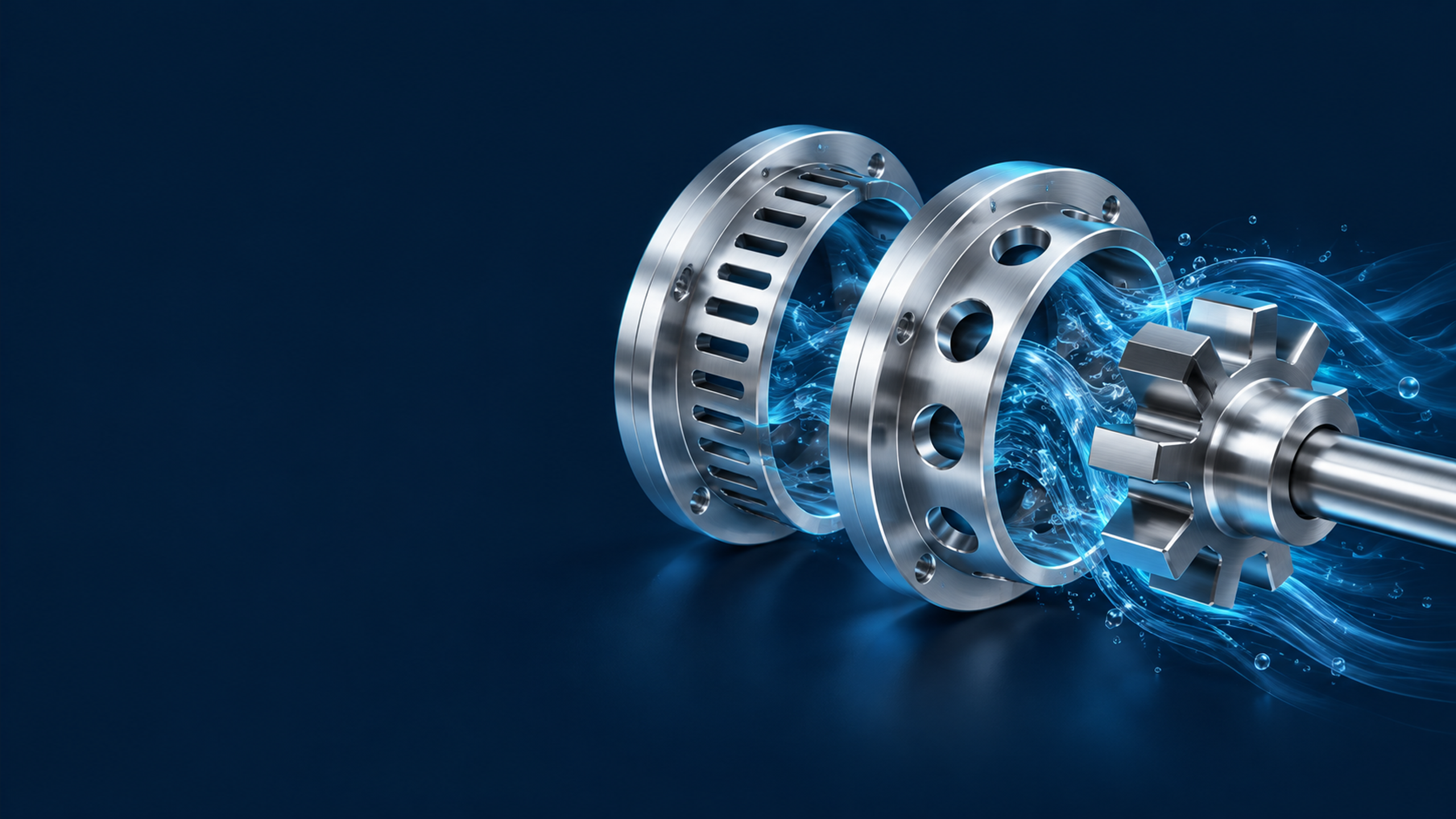
Other
Performance considerations in stator selection for high shear rotor-stator mixers
okozyuk.com
Published
Read complete publication for whole-document Find and printing. Browser Find and native printing on this reader include only loaded content.
6. Cleanability and CIP impact
Cleanability is not a secondary consideration in stator selection. In production systems, it is often one of the constraints that determines whether a head design remains practical at scale. A stator that performs well hydraulically can still fail as a production choice if it increases residue retention, extends CIP cycle time, raises disassembly frequency, or creates uncertainty in hygienic validation. For that reason, cleanability should be treated as an engineering selection variable alongside shear intensity, droplet size target, solids handling, viscosity range, and throughput.
6.1 Coarse and slotted heads
Coarse and slotted stators are generally the most forgiving from a CIP and washout standpoint. Their larger flow passages reduce the probability of product hold up and lower the risk of bridging by swollen powders, fibrous materials, seeds, pulp, semi gelled residues, or partially dissolved solids. From a fluid mechanical standpoint, the larger openings allow better flush velocity through the head at a given cleaning flow rate and make it less likely that residual material will remain sheltered in low exchange regions. These geometries are usually the preferred choice where the process includes difficult natural raw materials, incomplete pre hydration, botanical solids, or formulations known to leave stringy or deformable residue. They are also more robust where CIP capability is limited, where rapid turnaround is required, or where operators cannot rely on immediate post batch flushing every time. The tradeoff is obvious: the same open geometry that improves cleanability usually provides lower peak shear and less aggressive droplet or particle refinement than finer stator designs.
6.2 Square hole screens
Square hole screens sit in the middle of the cleanability range. They can usually be cleaned successfully in sanitary systems, but they are less tolerant than coarse or slotted heads when the batch contains sticky agglomerates, partially hydrated powders, proteinaceous deposits, or materials that dry into tenacious films. The smaller and more numerous apertures increase internal wetted perimeter and create more opportunities for local retention. In practice, cleaning performance depends strongly on operating discipline. Immediate post run flushing, adequate solution temperature, sufficient CIP flow velocity, and avoidance of extended hold time before cleaning all matter more with this geometry. If product is allowed to dry, gel, or crystallize inside the perforations, cleaning time and verification burden rise quickly. Square hole screens are therefore often a reasonable compromise where moderate particle size reduction or dispersion quality is needed, but the formulation is still manageable from a sanitation standpoint.
6.3 Fine emulsor screens
Fine emulsor screens are usually the most demanding option for CIP and hygienic maintenance. Their small perforations and high edge density are valuable for generating high local shear, but those same geometric features increase the likelihood of residue retention and make the head less tolerant of materials that smear, gel, crystallize, or partially solidify. This is especially relevant for proteins, hydrocolloids, wax bearing systems, fat containing products, sticky concentrates, and formulations with incomplete solvation. From an engineering perspective, the issue is not just "small holes are harder to clean." The finer geometry increases internal surface area, reduces characteristic passage dimension, and makes removal of adherent residue more dependent on cleaning chemistry, temperature, and local wall shear during CIP. As a result, these heads often require tighter cleaning control, warmer flush media, higher CIP velocities, more aggressive chemical sequencing, or more frequent manual inspection and disassembly. Fine emulsor heads can still be the correct process choice when the required emulsion quality or dispersion fineness justifies the sanitation burden. But that burden should be explicitly accounted for during selection rather than discovered later in production.
6.4 Hygienic processing note
For hygienic service, stator selection cannot be reduced to aperture pattern alone. Cleanability must be evaluated at the assembly and system level. The relevant question is not only whether the stator itself is easy to flush, but whether the full mixing head and surrounding wetted envelope can be cleaned, drained, inspected, and returned to service in a controlled and repeatable way.
That evaluation should include at least the following factors:
-
access to the head for inspection, manual verification, and washdown
-
drainability of the assembly in installed orientation
-
seal design and suitability for hygienic duty
-
internal surface finish and weld quality
-
elimination of crevices, dead legs, and shadowed flow regions
-
ease of disassembly and reassembly of wetted components
-
compatibility with CIP chemistry, temperature, and flow regime
-
validation burden for allergen, flavor, bioburden, or product changeover control
In food, dairy, beverage, personal care, and biopharma applications, these factors can carry as much weight as hydraulic performance. A stator pattern may look optimal for emulsification or dispersion duty yet still be the wrong engineering choice if it traps product, creates persistent low exchange regions, complicated CIP validation, or increases maintenance exposure. For that reason, stator selection should be handled as a multicriteria design decision. Sanitary construction, hygienic serviceability, and maintainability should be formal selection criteria, not afterthoughts, and should be weighed directly against emulsification duty, particle reduction target, viscosity window, solids sensitivity, and required throughput.