
Technical publication
Back to publications
Industrial applications
Hydrodynamic Cavitation in Pharmaceutical Particle Engineering, Crystallization, and Drug Delivery
okozyuk.com
Published
Read complete publication for whole-document Find and printing. Browser Find and native printing on this reader include only loaded content.
1 Introduction and Design Basis
This article applies standard hydraulic definitions, energy boundaries, residence time expressions, uncertainty requirements, and scale translation principles to pharmaceutical particle engineering. It develops the mechanisms, models, process variables, and acceptance criteria required to relate hydrodynamic cavitation and high pressure microchannel processing to pharmaceutical product quality.
Pharmaceutical particle engineering does not simply aim to minimize particle size. Its practical objective is to produce a reproducible particle or vesicle population that is physically stable, manufacturable, compatible with the intended route of administration, and capable of delivering the required dose and release profile.
Median particle size alone can be misleading. A formulation may still fail when the coarse tail, fines fraction, morphology, polymorphic form, surface chemistry, or free drug fraction remains uncontrolled. Development should therefore connect material attributes and process parameters to clinically and operationally relevant quality attributes [7-16].
This article examines four process families used in pharmaceutical particle engineering:
Top down processing: Techniques that reduce existing particles, droplets, agglomerates, or vesicles through fracture, deagglomeration, shear, impact, and interfacial breakup.
Bottom up processing: Methods that create particles directly from solution through controlled supersaturation, nucleation, growth, and stabilization.
Controlled hydrodynamic cavitation: An intensive flow process that uses pressure reduction, cavity formation, and collapse to promote mixing, particle breakage, nucleation, and surface treatment.
Lipid based delivery systems: Methods that use bilayer self-assembly and controlled mechanical remodeling to create and stabilize liposomes and related vesicles.
Across these process families, hydrodynamic cavitation and fixed geometry microchannel processing concentrate mechanical energy within a small liquid volume. Fluid acceleration, pressure reduction and recovery, turbulence, shear, impact, and cavity collapse can be used to connect raw material attributes with particle, crystal, droplet, or vesicle quality.
1.1 Critical Quality Attributes
Critical quality attributes should be defined before operating conditions are optimized. A target such as D50 is rarely sufficient by itself. D10, D90, distribution span, polydispersity, number weighted and volume weighted distributions, morphology, surface charge, crystal form, free drug, encapsulation efficiency, and release behavior may all be decisive. For sterile products, particulate burden, bioburden, endotoxin, container compatibility, filterability, and aseptic processing controls must also be incorporated [7-14,36-38].
Table 1.1. Representative critical quality attributes for pharmaceutical particles and liposomes.
| Attribute | Why it matters | Representative methods |
|---|---|---|
| D10, D50, D90, span, PDI | Controls dissolution, filtration, injectability, sedimentation, optical appearance, and dose uniformity. | Laser diffraction, DLS, nanoparticle tracking analysis, microscopy |
| Morphology and aspect ratio | Affects flow, packing, breakage, filtration, syringe ability, and aerodynamic behavior. | Optical microscopy, SEM, TEM, image analysis |
| Crystal form and crystallinity | Controls solubility, dissolution, stability, mechanical response, and possible conversion during processing. | Powder X ray diffraction, DSC, Raman, solid state NMR |
| Surface chemistry and zeta potential | Affects wetting, electrostatic stabilization, protein adsorption, aggregation, and biological interaction. | Electrophoretic mobility, XPS, surface tension, contact angle |
| Encapsulation efficiency and free drug | Determines dose distribution between carrier and continuous phase, toxicity, and release. | Chromatographic separation, ultrafiltration, HPLC or LC MS |
| Residual solvent and impurities | May limit safety, stability, and regulatory acceptability. | Gas chromatography, HPLC, ICP MS, extractables and leachables studies |
| Release profile and leakage | Determines exposure, shelf stability, and functional performance of the delivery system. | In vitro release, dialysis, flow through cells, accelerated leakage studies |
| Microbial attributes and sterility assurance | Essential for parenteral and ophthalmic products. | Bioburden, endotoxin, sterility testing, media fills, environmental monitoring |
1.2 Product Performance Begins with Particle Geometry and Interfaces
For equal mass of spherical particles, reducing diameter increases the total surface area in direct proportion to the inverse of diameter. The idealized gain can be large. Reducing a 100 µm particle to 1 µm increases specific surface area by a factor of 100, provided that the particles remain discrete and the surface is accessible to the dissolution medium. In practice, aggregation, poor wetting, hydrophobic surfaces, a diffusion layer, or crystal growth can partially eliminate this theoretical advantage [6].
The Noyes and Whitney form expresses the central relation between accessible surface area and dissolution rate [6]:
where M is the dissolved mass; t is time; k is the overall mass transfer coefficient; A is the accessible particle surface area; Cₛ is the concentration at the particle surface; and C is the concentration in the bulk liquid.
For monodisperse spherical particles, the specific surface area is:
where A is total particle surface area; m is particle mass; ρₚ is particle density; and dₚ is the diameter of a spherical particle.
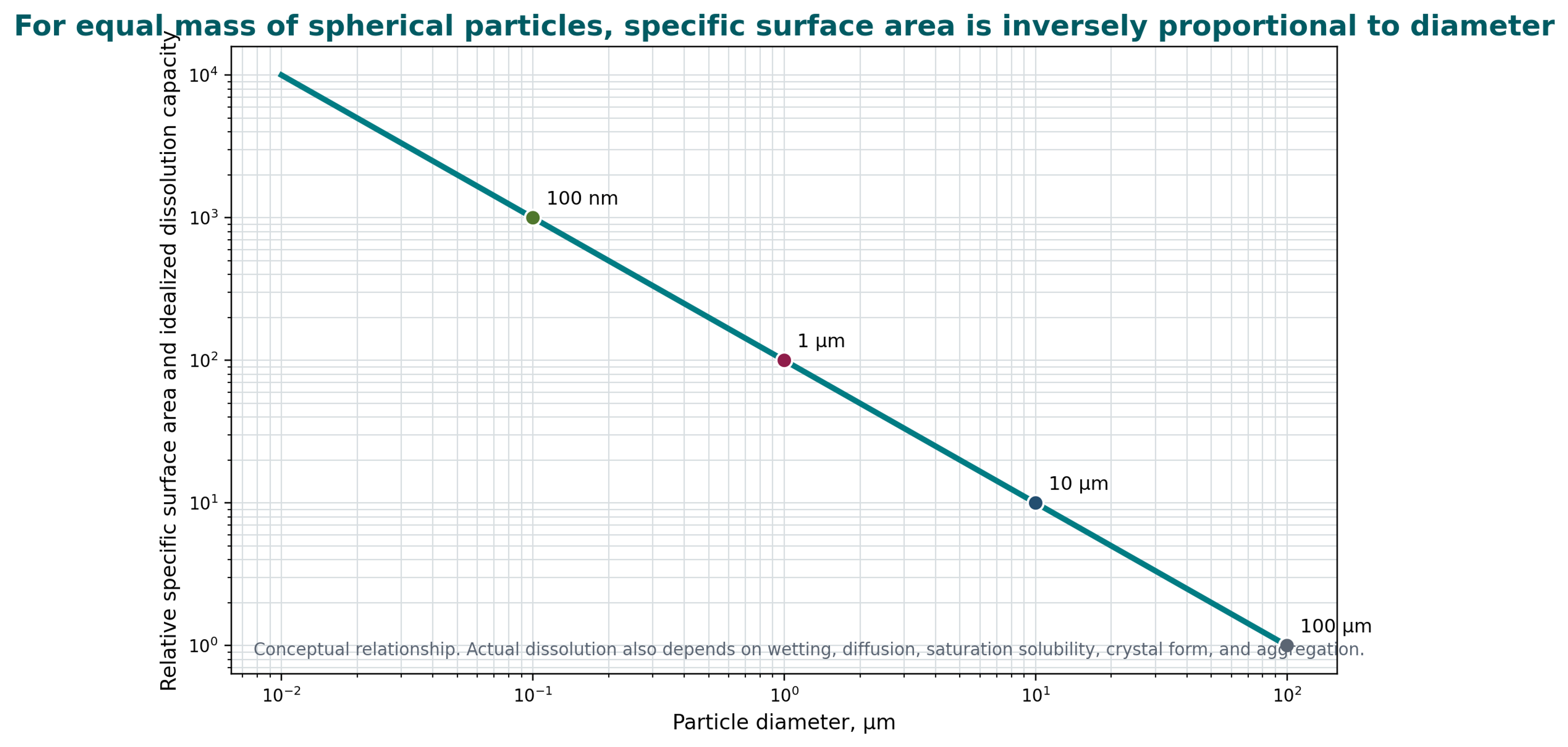
Figure 1.1. Idealized influence of particle diameter on specific surface area and dissolution capacity for a fixed particle mass. Calculation based on Equations (1.1) and (1.2) [42].
Very small crystals can exhibit curvature dependent solubility. The Ostwald and Freundlich relation indicates that the apparent saturation concentration rises as particle radius decreases. This effect can help explain improved dissolution, but it can also drive Ostwald ripening because the smallest particles are thermodynamically less stable and may dissolve while larger particles grow.
where Cₛ(r) is the saturation concentration for a particle of radius r; Cₛ,∞ is the saturation concentration at a planar interface; γ is interfacial energy; Vₘ is molar volume; R is the gas constant; and T is absolute temperature.
Brownian diffusion also becomes more important as hydrodynamic diameter decreases. The Stokes and Einstein expression is useful for estimating molecular or nanoparticle diffusivity in dilute Newtonian systems:
where D is the translational diffusion coefficient, is the Boltzmann constant, T is absolute temperature, μ is dynamic viscosity, and dₕ is hydrodynamic diameter.
| Engineering implication: Particle size reduction creates new surface area and new interfacial energy. The stabilizer system must be developed at the same time as the energy input. A process that creates small particles faster than the formulation can stabilize them may produce temporary size reduction followed by aggregation, ripening, or leakage. |
|---|