
Technical publication
Back to publications
Industrial applications
Hydrodynamic Cavitation in Food and Fermentation Processing
okozyuk.com
Published
Read complete publication for whole-document Find and printing. Browser Find and native printing on this reader include only loaded content.
10 Cross Cutting Design, Scale Up, and Economics
10.1 Product first process development
A cavitation process should begin with critical quality attributes rather than with a preferred device. The product specification may be a microbial log reduction, D90, d32, viscosity at a defined shear rate, extraction yield, enzyme residual activity, overrun, bitterness, color, or shelf life endpoint. The device and operating condition are selected only after the required response and acceptable quality losses are defined [6,7].
A practical development sequence is characterize the untreated feed; screen device geometry and severity at controlled temperature; identify response plateaus and quality loss thresholds; optimize pass count or residence time; integrate heating, cooling, gas, separation, and holding; perform challenge and shelf life studies; and then scale by preserving the mechanisms that control the endpoint. At each stage, the energy boundary must include auxiliary pumping and cooling.
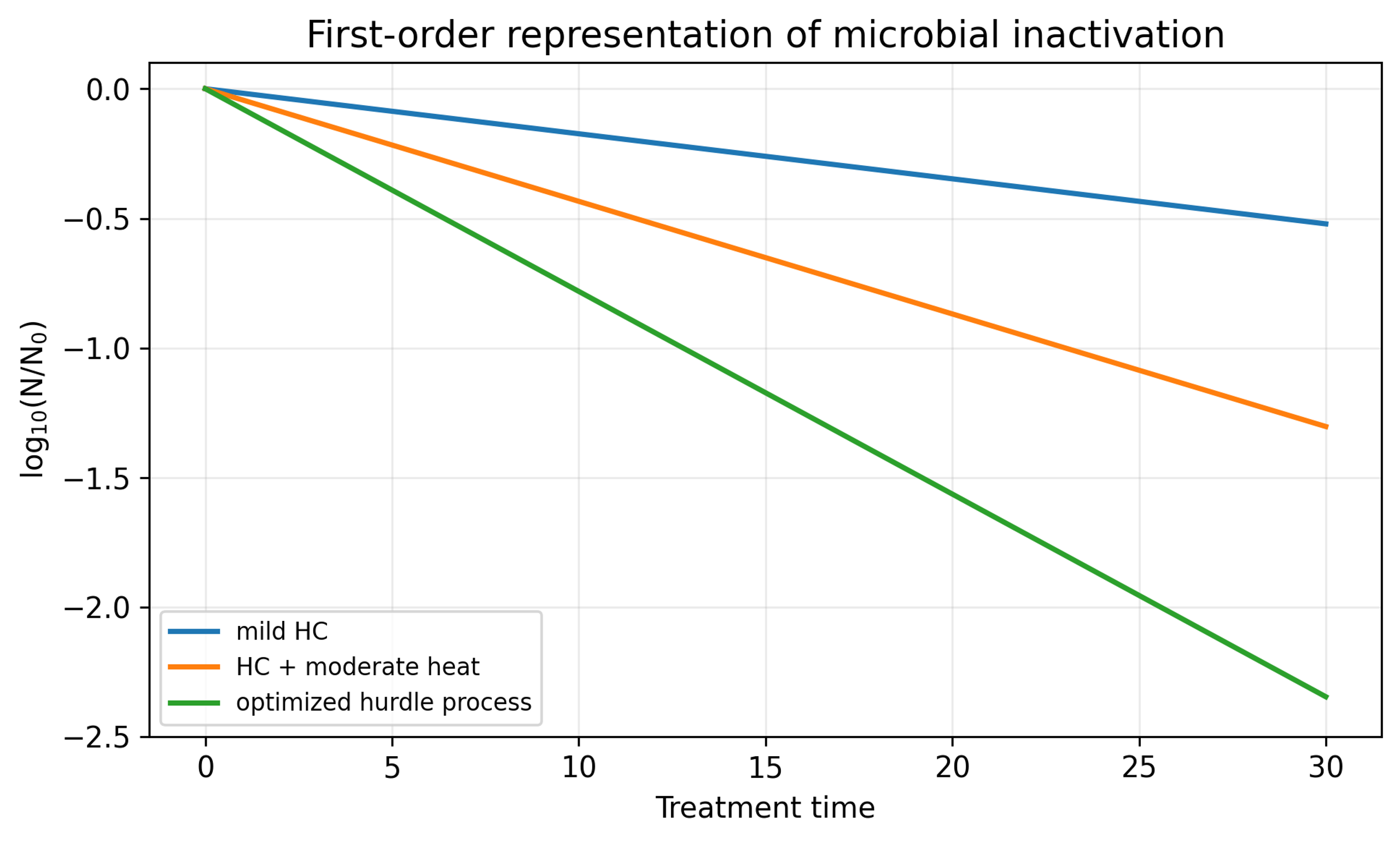
Figure 10.1. Illustrative first order microbial inactivation curves for mild cavitation, cavitation plus moderate heat, and an optimized hurdle process. [19,20,25-27].
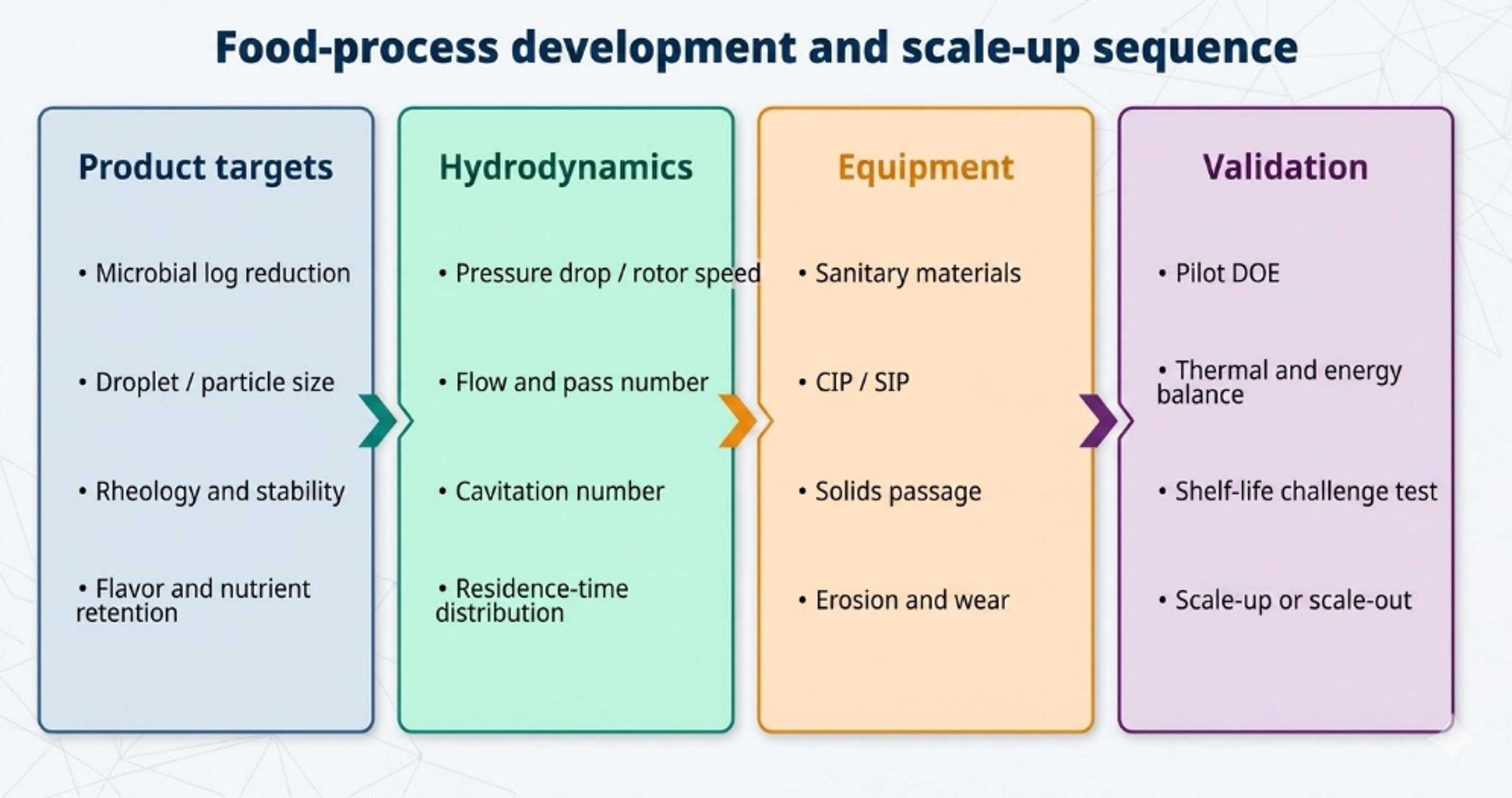
Figure 10.2. Product development and scale up sequence for food cavitation processes [66].
10.2 Scale up
Geometric scale up of a Venturi, orifice, vortex, or rotor changes the distribution of turbulence, cavity residence, wall proximity, and heat loss. Matching cavitation number, pressure drop, or tip speed individually cannot guarantee the same product response. At minimum, scale up should compare flow per active volume, pass frequency, specific energy, pressure recovery profile, maximum and mean temperature, residence time distribution, solids passage, and the local stress scale that controls breakup [5,7,8].
Scale out is attractive when a small device has a validated product window. Parallel identical modules preserve geometry and can provide redundancy, cleanability, and turndown. The 2026 vortex emulsification study found that parallel devices preserved droplet size distribution more closely than geometric scale up, although energy effectiveness still depended on manifold design and operating point [39]. Parallel trains require balanced flow, identical backpressure, and hygienic manifolds without stagnant branches.
Dynamic rotor equipment introduces additional similarity groups: tip speed, rotor diameter, hole geometry, frequency, clearance, torque, and mechanical power per volume. Large rotors may be limited by stress, seal speed, vibration, and bearing load. Multiple smaller rotors or stages may provide a more practical scale up path than a single geometrically enlarged machine.
10.3 Sanitary engineering, erosion, and maintenance
Food contact materials should resist product chemistry, cleaning chemicals, and cyclic mechanical load. Cavitation zones must be placed away from vulnerable surfaces when possible, and wear parts should be inspectable and replaceable. A gradual increase in pressure drop, metal particles, vibration, or loss of product response can indicate obstruction or erosion. Baseline thickness and surface finish measurements are useful for high severity service.
Clean in place validation should include turbulent cleaning flow through the same restrictions and rotor passages used in production. Gums, starch, egg protein, hop resins, fruit fibers, and dairy deposits require different alkaline, acidic, enzymatic, or oxidative cleaning sequences. The process should be fully drainable, and gas pockets should not prevent wetting of the active zone. Sanitary performance must be confirmed by rinse chemistry, visual inspection, ATP screening where appropriate, and microbiological verification.
10.4 Economic assessment
Economic benefit can arise from shorter batch time, higher extraction or ethanol yield, lower enzyme or stabilizer dose, reduced homogenizing pressure, eliminated milling or boiling, higher evaporator solids, longer production runs between cleaning cycles, lower wastewater generation, or new product functionality. These benefits must be separated from marketing claims and quantified with plant data.
A discounted cash flow assessment should include equipment, pump or motor, variable frequency drive, cooling, separators, installation, validation, cleaning, maintenance, wear parts, and downtime. The energy comparison should use matched system boundaries and production rates. A high process yield in the active device can be offset by inefficient recirculation or cooling, while modest direct energy saving may still be valuable if the process increases sellable yield or plant capacity.
Table 10.1. Scale up and validation checklist for industrial food cavitation.
| Workstream | Required evidence before commercial release |
|---|---|
| Product specification | Defined microbial, enzymatic, physical, chemical, sensory, and shelf life acceptance limits |
| Feed characterization | Composition, pH, density, rheology, solids and particle size, interfacial tension, dissolved gas, temperature range |
| Hydraulic characterization | Device drawing, pressure reference locations, flow curve, pressure drop, cavitation regime, pass frequency, and RTD |
| Thermal and energy balance | Electrical, shaft, and hydraulic power; temperature history; cooling duty; heat loss; specific energy |
| Process robustness | Feed variability, start up, shutdown, turndown, blockage response, gas sensitivity, reproducibility |
| Microbiological validation | Target organism challenge, worst case residence and temperature, and microbiological stability |
| Product quality | DSD or PSD, rheology, separation stability, nutrient and flavor retention, intended end use performance |
| Sanitation and durability | CIP/SIP validation, drainability, fouling trend, erosion and wear inspection, spare parts strategy |
| Scale up strategy | Similarity criteria, pilot to commercial correlation, parallelization balance, manifold design |
| Economics | Capital, energy, maintenance, cleaning, consumables, yield, capacity, labor, wastewater, and sensitivity analysis |