
Technical publication
Back to publications
Other
Emulsification and Homogenization in Rotor-Stator Mixers
okozyuk.com
Published
Read complete publication for whole-document Find and printing. Browser Find and native printing on this reader include only loaded content.
17 Troubleshooting, hygiene, reliability, and safety
Long term process performance depends on the condition of the equipment as well as the selected formulation and operating point. Product defects, loss of cleaning effectiveness, and mechanical deterioration can produce similar changes in power or droplet size. Diagnosis should therefore combine product measurements with flow, temperature, pressure, vibration, and inspection records before corrective action is chosen.
17.1 Troubleshooting logic
Troubleshooting is most effective when the time at which the defect appears is established first. A product that is coarse immediately after processing suggests inadequate stress or exposure, excessive interfacial resistance, or a damaged generator. A satisfactory initial distribution that becomes coarse during storage suggests instability or a measurement artifact. A broad distribution can also arise from bypass, poor bulk circulation, intermittent feeding, or unequal parallel streams. Foam and unstable power provide additional evidence of air ingress. The diagnosis should be confirmed by measurements before an operating change is selected.
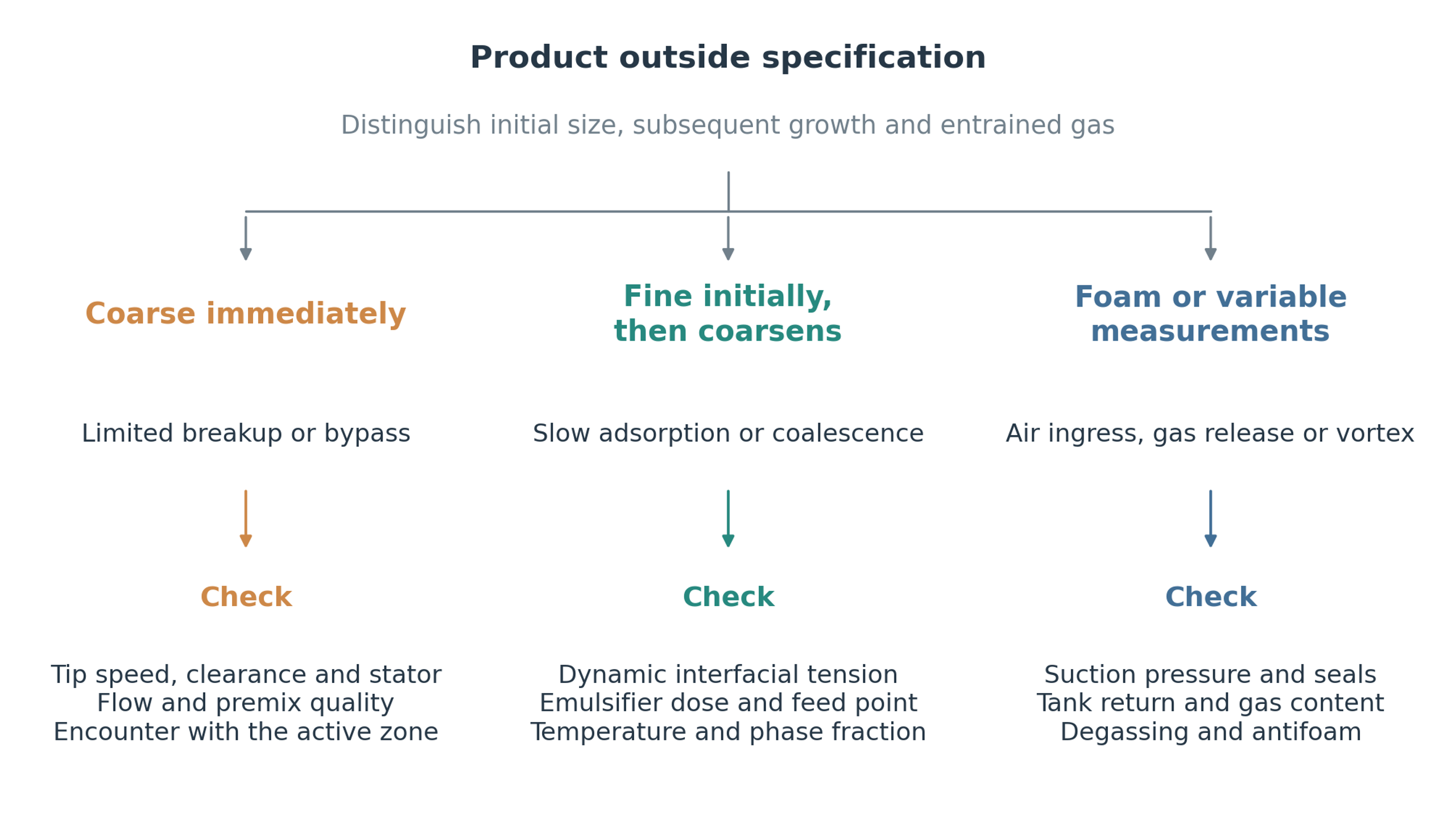
Figure 17.1. Diagnostic sequence for an emulsion that is coarse, unstable, or affected by entrained gas. Immediate size, subsequent growth, and variability guide separate investigations of mechanical exposure, interfacial stabilization, and air incorporation.
Table 17.1. Common failure modes and corrective actions.
| Observation | Probable cause | Diagnostic check | Corrective action |
|---|---|---|---|
| and both coarse | Stress or exposure too low | Speed, flow, gap, stator condition | Increase speed within limits, increase passes, use finer generator |
| Mean acceptable but high | Bypass or poor premix | Tank circulation, sampling, feed path | Improve bulk turnover, premix, or manifold balance |
| Size decreases then increases with time | Recoalescence or flocculation | Immediate and delayed DSD, microscopy | Increase or change emulsifier, cool, reduce collision exposure |
| Size improves then worsens at high speed | Heating, air, phase inversion, overprocessing | Temperature, power, conductivity, foam | Reduce speed, cool, control feed, deaerate |
| Excessive foam | Free surface vortex or suction leak | Submergence, seals, suction pressure | Increase submergence, eliminate leak, submerge return |
| Power rises during batch | Viscosity growth, blockage, cooling loss | Rheology, pressure, generator inspection | Add bulk agitator, clean, control temperature |
| Power falls while size worsens | Wear, gas loading, phase change | Torque baseline, stator inspection, conductivity | Replace generator, remove gas, confirm topology |
| Pressure drop drifts upward | Fouling or solids buildup | Clean water baseline, inspection | Clean, enlarge opening, improve premix filtration |
| Metallic particles | Rotor stator contact or erosion | Vibration, gap, magnetic or elemental analysis | Stop, inspect bearings and gap, replace parts |
| Poor batch repeatability | Variable premix, temperature, or addition | Batch records and raw material properties | Standardize preparation and endpoint control |
17.2 Hygienic design and cleaning
Hygienic performance depends on the complete wetted flow path, including the workhead, seals, connections, and adjacent pipework. Food, cosmetic, and pharmaceutical applications require suitable surface finish, drainability, compatible materials, and a validated cleaning procedure. Fine openings and multiple stages can retain product if cleaning flow does not reach them effectively. Cleaning conditions should therefore be defined by the required time, temperature, flow, chemistry, and verification method rather than by the mixer designation alone.
The need for disassembly depends on the generator design and the cleaning requirements. When cleaning in place is used, its effectiveness must be demonstrated for the complete assembly. Where disassembly is necessary, handling and reassembly should preserve clearance, balance, and surface finish. Cleaning agents must be compatible with the wetted metals, coatings, and sealing materials.
17.3 Mechanical reliability
Mechanical reliability establishes the range within which hydrodynamic optimization can be performed. The rotating assembly must be suitable for the maximum intended speed, temperature, density, and viscosity. Shaft dynamics, bearing life, rotor balance, seal loading, and thermal expansion require engineering assessment. Operation with an incompletely filled head can remove liquid cooling and damping. Appropriate monitoring and protective interlocks should address loss of liquid supply, excessive vibration, and temperature excursions.
Periodic rotor and pressure loads can excite structural vibration even when average torque is acceptable. Their frequency content should be considered in relation to the shaft, housing, pipework, and supports. Where cyclic excitation is substantial, fatigue and vibration assessments should accompany the process design. Flexible connections can isolate some transmitted motion, but do not resolve the underlying cause of excessive vibration.
17.4 Process safety
A process hazard assessment should consider the combined equipment and material conditions, including rotating components, retained pressure, hot product, volatile liquids, powder addition, biological material, and cleaning chemicals. Cavitation can contribute to erosion and gas release. Relief, containment, and operating limits should be established for the complete installation, including a blocked outlet, thermal expansion, pump shutoff pressure, and possible phase change. The relevant requirements depend on the actual service and installation.