
Technical publication
Back to publications
Industrial applications
Design and Operating Principles of Rotor-Stator Mixers
okozyuk.com
Published
Read complete publication for whole-document Find and printing. Browser Find and native printing on this reader include only loaded content.
12. Criteria and Principles for Selecting Rotor-Stator Equipment
Equipment selection should begin with the rate limiting process step. Attempting to apply one mixer configuration throughout every stage of a process may reduce overall efficiency. Dry powders first require effective wetting, initial deagglomeration, and transport into the liquid; fine finishing screens are most appropriate after those steps. For a stable premix that requires additional droplet reduction, a high gradient generator or multistage system may be appropriate. In highly viscous products, feed supply and bulk tank circulation may be more limiting than local velocity gradient. Intentional cavitation must be justified by experimentally verified pressure conditions and a defined collapse region rather than a general high shear designation.
Feed properties, including initial particle size, deformability, and abrasiveness, must be evaluated against actual passage dimensions such as gaps, channel profiles, and perforation diameters:
-
Fibrous inclusions: May wrap around moving elements, cause jamming, and partially obstruct stator passages.
-
Hard abrasive particles: Cause abrasive wear and contact damage to precision rotor-stator surfaces.
-
Changes in solids concentration: Alter fluid rheology, hydraulic resistance, and the machine head versus flow characteristic.
For temperature-sensitive materials, limits on thermal exposure are critical. Controlled pass counts with efficient external heat exchange are preferable to prolonged, uncontrolled recirculation. These considerations support preliminary design, but final operating limits must be established by representative pilot-scale experiments.
Selection should begin with the limiting process step. Powder at the liquid surface must first be wetted and incorporated before a restrictive fine dispersion screen is introduced. A stable premix requiring further droplet reduction may benefit from a fine generator or an additional stage. For viscous products, material delivery and tank turnover may be limiting. Intentional cavitation requires confirmed pressure conditions and a suitable collapse zone, not merely a high-shear designation.
Initial particle size, deformability, and abrasiveness must be compared with actual openings and gaps. Fibers may block passages, hard inclusions may cause contact damage, and variations in solids content may change the head versus flow curve. Temperature sensitive products may benefit from controlled passages with external cooling rather than extended recirculation. These are preliminary design considerations; the allowable operating range must be established through representative product tests.
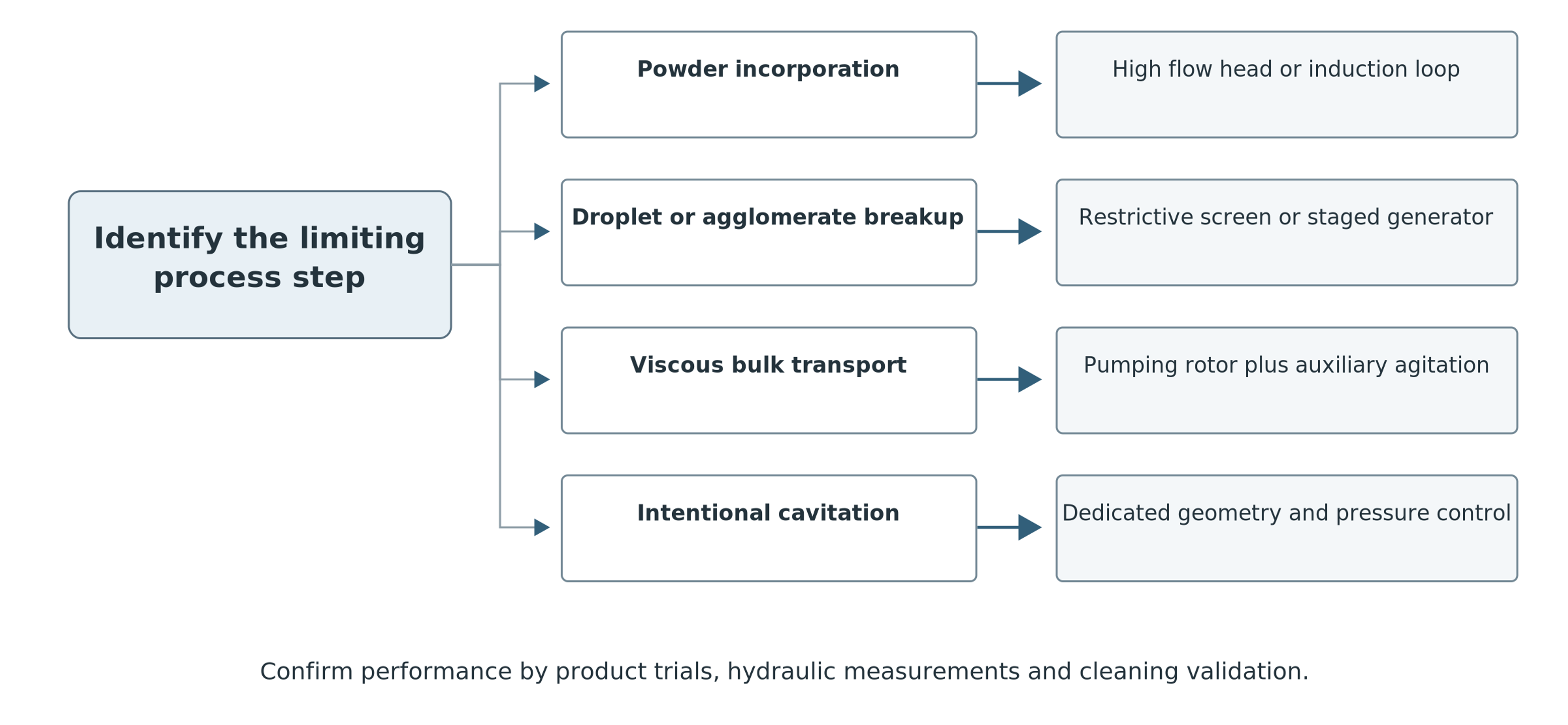
Figure 12.1. Qualitative equipment selection logic based on the limiting process stage. [1].
Table 12.1. Initial equipment selection recommendations for different process duties
| Process objective | Recommended initial geometry | Verification test |
|---|---|---|
| Rapid powder wetting | Open high throughput batch head, powder induction loop, or coarse inline stage. | Time for complete addition without dry lumps, floating powder, or air entrainment. |
| Polymer hydration | High capacity head followed by moderate shear after wetting. | Viscosity buildup, residual gel particles, and temperature rise. |
| Fine liquid-liquid emulsion | Finely perforated stator or multistage inline head. | Sauter diameter d32, distribution width, recoalescence on storage, and energy per unit volume. |
| Pigment or nanoparticle deagglomeration | High stress rotor-stator assembly, potentially multistage, with controlled viscosity. | Final agglomerate size, color intensity or specific surface area relative to energy consumed. |
| Breakup of soft solid inclusions | Slotted stator and cutting rotor. | Maximum feed size, fragment size distribution, and susceptibility to blockage. |
| Viscous food product texturing | Shear pump or coarse multiring head. | Texture, throughput, torque, and temperature history. |
| Rotor-pulsation treatment | Toothed or channeled rotor with phase-matched stator. | Pressure spectrum, passage frequency, and product response. |
| Hydrodynamic cavitation | Dedicated cavities, holes, pins, or grooves with pressure control. | Cavitation onset, vapor distribution, erosion rate, and process yield. |
| Hygienic multiproduct operation | Easy to disassemble or CIP capable head with verified drainability. | Cleaning solution coverage, residual contamination, and product-specific cleaning validation. |
12.1 Methodology for Planning Application-Specific Trials
Experimental programs for rotor-stator equipment must distinguish clearly between process objectives and identify the limiting physicochemical stages. A single universal testing protocol can give misleading results because hydrodynamic requirements differ substantially between heterogeneous systems.
-
Powder wetting and polymer hydration: Trials should document ingredient feed rate and location, time-dependent viscosity, and the residual amount of unwetted material. The ability to induct dry powder at the beginning of a process and to maintain circulation after the mixture has thickened are distinct design requirements. A fine finishing screen cannot compensate for inadequate inlet suction or poor incorporation geometry.
-
Emulsification: Full droplet size distributions should be compared at controlled phase volume fractions, stabilizer concentrations and types, and thermal conditions. Samples collected immediately after the head and again after a defined holding period distinguish breakup during processing from subsequent recoalescence. Long-term storage stability depends on the overall formulation chemistry and cannot be guaranteed by a high instantaneous shear rate alone.
-
Solid and pigment dispersion: Before testing, the desired outcome must be defined, whether it involves breaking agglomerates to a specified size, releasing primary particles, developing color intensity, attaining a target specific surface area, or producing a particular rheological structure. These objectives require different exposure histories. The deagglomeration classification proposed by Bałdyga and Malik provides a useful framework [17]. Specific mechanical energy input should always be evaluated against a measured benefit and the mass of treated product.