
Technical publication
Back to publications
Industrial applications
Hydrodynamic Cavitation in Pharmaceutical Particle Engineering, Crystallization, and Drug Delivery
okozyuk.com
Published
Read complete publication for whole-document Find and printing. Browser Find and native printing on this reader include only loaded content.
8 Quality by Design, Process Analytical Technology, and Manufacturing Control
8.1 Quality Target Product Profile and Risk Analysis
A Quality by Design approach begins with the quality target product profile and the intended route of administration. The development team identifies critical quality attributes, evaluates material attributes and process parameters that can affect them, and builds knowledge through designed experiments and mechanistic understanding. The design space is a multidimensional region in which the process has been shown to deliver acceptable quality. It is not simply a pressure range [9–12,16].
For particle engineering, a cause and effect analysis should include feed particle size, crystal form, lipid or polymer grade, stabilizer molecular weight, solvent composition, dissolved gas, viscosity, temperature, pressure, back pressure, flow rate, chamber geometry, pass count, loop volume, hold time, oxygen exposure, filter history, equipment wear, and cleaning state. The priority of each factor depends on the dosage form and mechanism.
| CQA | Pressure | Passes | Flow | Chamber | Temperature | Solids or lipid | Stabilizer | Solvent ratio | Hold time |
|---|---|---|---|---|---|---|---|---|---|
| D50 | H | H | M | H | M | M | M | L | L |
| Span or PDI | H | H | M | H | M | M | H | L | M |
| Morphology | M | M | M | M | H | M | M | M | H |
| Polymorph | M | M | L | M | H | M | M | H | H |
| Dissolution | H | H | M | H | M | H | H | M | H |
| Zeta potential | M | M | L | M | M | H | H | M | H |
| Encapsulation | H | H | M | H | H | H | H | H | H |
| Leakage | H | H | M | H | H | H | H | M | H |
| Impurities | M | H | M | M | H | M | M | H | H |
| Sterility | L | M | M | M | H | M | M | M | H |
Figure 8.1. Conceptual risk screening matrix connecting critical process parameters with critical quality attributes [42].
Table 8.1. Examples of material attributes, process parameters, and linked quality attributes.
| Category | Variable | Potentially affected attributes | Typical controls |
|---|---|---|---|
| Material attribute | API crystal form and mechanical strength | Breakage rate, limiting size, dissolution, polymorphic conversion | Incoming PXRD, particle imaging, mechanical screening |
| Material attribute | Lipid composition and transition temperature | Vesicle size, leakage, encapsulation, release, oxidation | Supplier qualification, DSC, peroxide value, composition testing |
| Formulation | Stabilizer type and concentration | Aggregation, span, zeta potential, free drug, viscosity | Design of experiments, adsorption or surface coverage study |
| Hydraulic parameter | Pressure and back pressure | Velocity, cavitation number, shear, impact, temperature rise | Calibrated pressure sensors, alarm limits, trace review |
| Hydraulic parameter | Flow rate and chamber geometry | Residence time, dissipation, mixing, pass efficiency | Flow meter, chamber identification, wear monitoring |
| Exposure history | Pass count and recirculation ratio | Size, span, leakage, impurities, temperature history | Batch mass balance, loop volume, controlled sampling |
| Thermal parameter | Inlet and outlet temperature | Viscosity, vapor pressure, lipid phase state, degradation | Heat exchanger control, continuous temperature recording |
| Downstream hold | Time, agitation, gas exposure | Growth, aggregation, oxidation, leakage, bioburden | Validated hold time, inerting, agitation and temperature limits |
8.2 Design of Experiments for Pressure, Passes, and Formulation
A useful screening design includes both formulation and process factors. For a nanosuspension, factors may include stabilizer type, stabilizer to drug ratio, solids concentration, pressure, pass count, chamber, temperature, and ionic strength. Responses should include D10, D50, D90, span, viscosity, dissolution, sedimentation, assay, impurities, and crystal form. For liposomes, responses should add PDI, encapsulation efficiency, free drug, leakage, lipid degradation, lamellarity, and release.
Sequential experimentation is more efficient than a single very large design. The first stage identifies dominant factors and unsafe regions. A second response surface design defines curvature and interactions. A third stage confirms robustness near the proposed set point and at material attribute extremes. Mechanistic modeling can reduce the number of experiments when it is anchored to measurements. Pressure, pass count, and temperature should be treated as interacting variables rather than optimized one at a time.
8.3 Process Analytical Technology
Process analytical technology can shorten feedback time and protect against drift. Candidate measurements include pressure and temperature traces, flow, density, viscosity, conductivity, turbidity, near infrared or Raman spectra, focused beam reflectance measurement, particle vision microscopy, inline imaging, and at line laser diffraction or DLS. No single method is sufficient for all products. Measurement location, dilution, sampling shear, and time delay must be included in the method design [13,37,38].
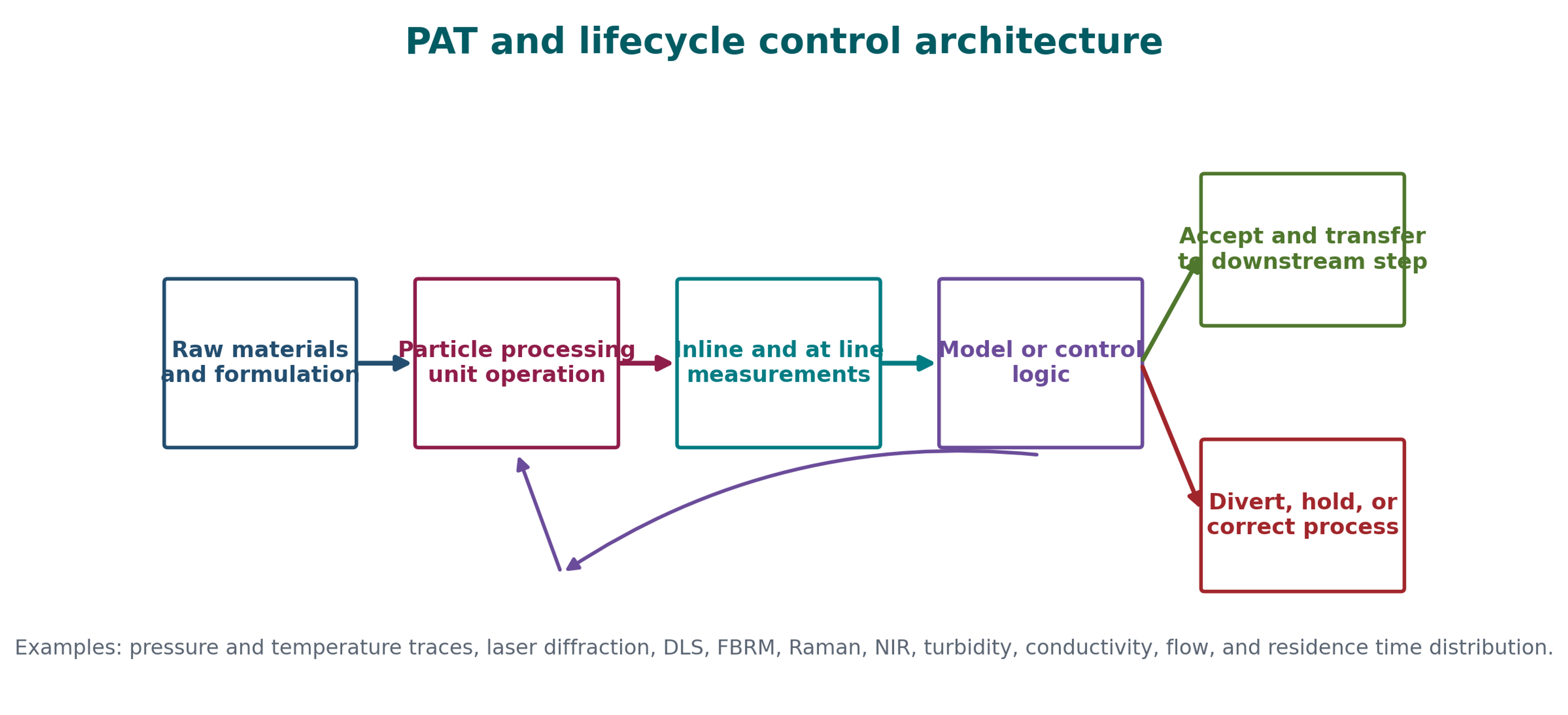
Figure 8.2. Representative process analytical technology and feedback control architecture for a continuous or semicontinuous particle process [42].
A PAT signal should be linked to a material decision. For example, a pressure trace can detect pump or chamber drift, but it does not directly prove particle size. An inline optical signal may correlate with size, but the correlation must be validated across formulation and temperature. The control strategy can use direct measurement, a soft sensor, or a combination. Startup, shutdown, and disturbance material should be tracked and diverted when the state is outside the validated acceptance region.
8.4 Residence Time Distribution and Traceability
Continuous and recirculating systems contain a distribution of residence times and pass histories. The nominal residence time in Equation (2.7) is only a mean. A residence time distribution, E(t), describes the probability density for material leaving at time t after a tracer input. It is normalized as:
where E(t) is the exit age distribution. The integral equals 1 when all tracer is recovered and the system mass balance is complete.
Residence time distribution testing can reveal bypass, dead volume, broad mixing, or long tails. These features are important when product quality changes rapidly with exposure or when startup and shutdown material must be separated. For recirculating systems, a pass distribution model may be more informative than a conventional single pass residence time distribution. The model should be checked by tracer experiments at representative viscosity and flow.
8.5 Cleaning, Sterile Processing, and Material Compatibility
The manufacturing system should be designed for cleanability, drainability, inspection, and material compatibility. Small channels can retain product or cleaning solution. Cleaning validation should address the hardest to clean formulation and the most difficult location. Where clean in place or steam in place is used, gasket materials, ceramics, seals, pressure sensors, and surface finishes must tolerate the cycle without altering hydraulic performance.
For sterile drug products, the process sequence must integrate bioburden control, sterilization or aseptic processing, sterile filtration where feasible, sterile connections, environmental control, and validated hold times. A nominal particle size below 200 nm may support filtration through a 0.22 µm membrane, but the full distribution, aggregation, viscosity, filter loading, drug adsorption, and vesicle deformation determine actual filterability. Sterile filtration must be demonstrated with product specific bacterial retention and integrity testing [7,36].
Materials of construction can contribute extractables, leachables, metal ions, or wear particles. This is particularly important for oxidative lipids, proteins, nucleic acids, and long campaigns. A risk assessment should consider contact time, pressure, temperature, solvent, pH, cleaning chemicals, and component replacement history. Baseline and aged equipment studies can help establish preventive maintenance limits.
8.6 Scale Up and Lifecycle Validation
Scale up should maintain the local processing environment that controls quality. For parallel microchannel systems, local channel geometry can remain constant while throughput increases through additional channels. Flow balance and pressure consistency across channels must be verified. For cavitation devices, geometric similarity alone may not preserve cavity inception, cloud structure, and collapse location. The scale up plan should identify the governing dimensionless groups, pressure recovery pattern, residence time, and heat removal requirement [1,3–5,39].
Process validation should demonstrate that the commercial process can reproducibly deliver the required attributes within the defined control strategy. Continued process verification should trend size distributions, pressure and flow, temperature, pass count, yield, impurities, filter performance, and equipment wear. Changes to chamber, pump, scale, material supplier, lipid grade, stabilizer, or analytical method should be evaluated through the pharmaceutical quality system [11,14].
Table 8.2. Scale up and validation checklist.
| Area | Questions to answer before commercial transfer |
|---|---|
| Mechanism | Is the process controlled by fracture, deagglomeration, droplet breakup, cavitation collapse, micromixing, nucleation, growth, or a combination? |
| Hydraulics | Are pressure, back pressure, flow, channel dimensions, active volume, and residence time representative? |
| Thermal control | Is temperature rise per pass and cumulative temperature history controlled at the commercial scale? |
| Pass history | Does every portion of material receive the intended number and severity of passes? |
| Formulation | Are viscosity, solids loading, lipid phase behavior, dissolved gas, and stabilizer coverage equivalent? |
| Equipment condition | Are chamber wear, pump pulsation, seals, surfaces, and sensor calibration within acceptance limits? |
| Sampling and PAT | Do sampling methods preserve the product state, and are models valid at commercial scale? |
| Cleaning and sterility | Can the equipment be cleaned, sterilized, drained, inspected, and reassembled without hydraulic drift? |
| Lifecycle management | Are replacement criteria, continued verification, deviation handling, and change control defined? |