
Technical publication
Back to publications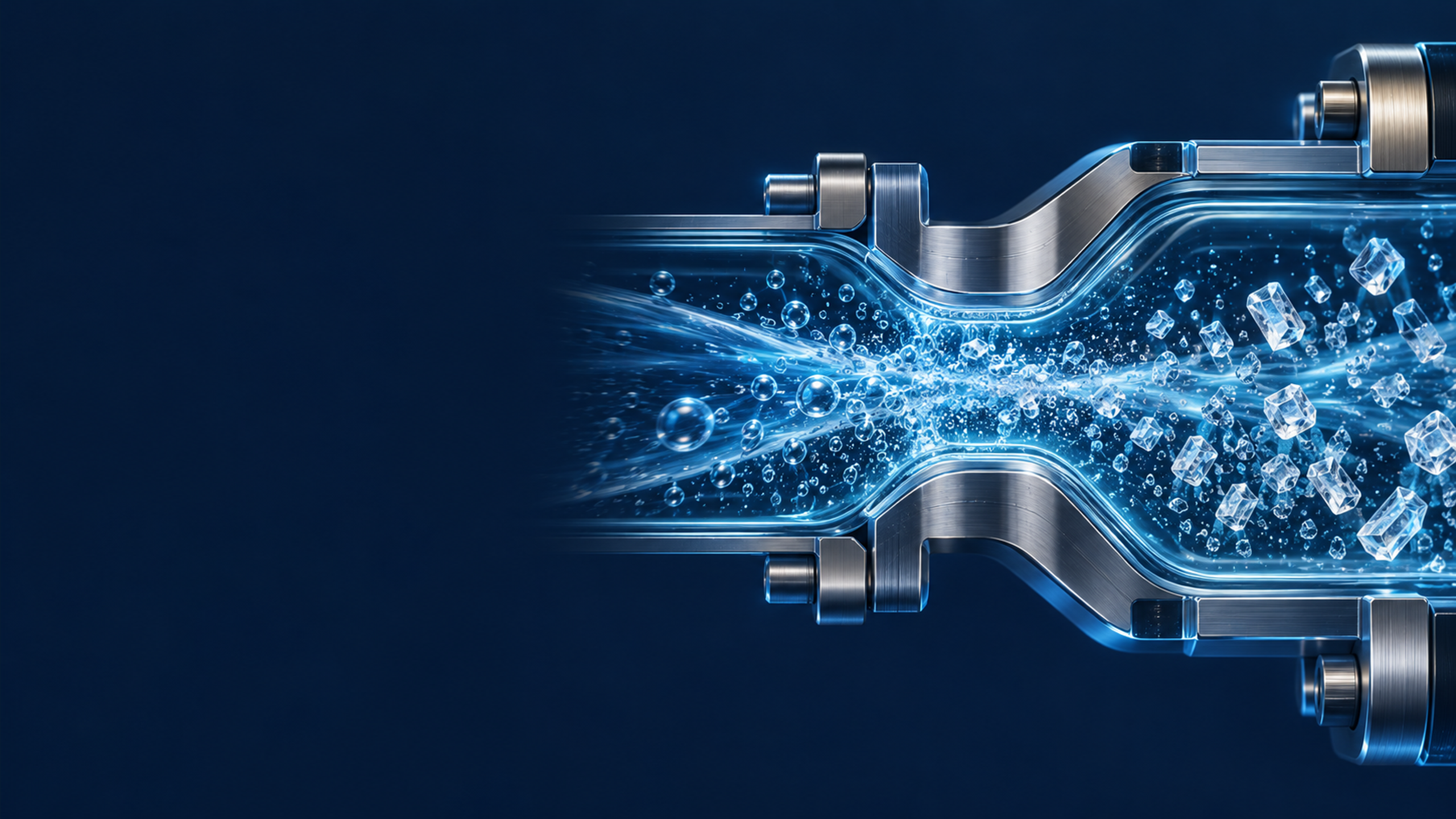
Industrial applications
Hydrodynamic Cavitation in Pharmaceutical Particle Engineering, Crystallization, and Drug Delivery
okozyuk.com
Published
Read complete publication for whole-document Find and printing. Browser Find and native printing on this reader include only loaded content.
10 Technology Comparison and Practical Decision Framework
10.1 Comparative Strengths and Limitations
No single technology is best for every active ingredient or dosage form. Media milling can provide robust nanosuspension production but requires media control and may involve long processing times. Jet milling is dry and scalable but may be inefficient for ductile crystals or very small targets. High pressure homogenization is well suited to liquid dispersions, emulsions, and liposomes, but it requires pressure equipment, cooling, and careful control of pass history. Controlled hydrodynamic cavitation can combine breakage, mixing, nucleation, and surface treatment, but the cavitation field must be characterized and equipment wear managed. Impinging jet crystallization provides rapid bottom up formation when solvent and antisolvent mixing controls nucleation, but long term stabilization and downstream solvent removal remain essential [1,17–35,40,41].
Table 10.1. Practical comparison of pharmaceutical particle engineering technologies.
| Technology | Primary mechanism | Typical strengths | Principal risks or limitations |
|---|---|---|---|
| Rotor stator wet milling | Shear and circulation | Simple equipment, easy premixing, useful for coarse dispersion. | Limited submicron efficiency, broad stress field, heat at high tip speed. |
| Wet media milling | Attrition and collision with media | Established nanosuspension capability, high solids possible. | Media wear, separation, cleaning, long time, temperature control. |
| Jet milling | High velocity gas collision | Dry process, no liquid solvent, established powder handling. | Broad fines, electrostatics, low efficiency for some crystals, dust containment. |
| High pressure valve homogenization | Pressure drop, shear, turbulence, impact | Emulsions and suspensions, continuous operation. | Valve wear, heat, pass variability, possible broad distribution. |
| Microfluidizer processing | Fixed geometry microchannel shear, impact, turbulence | Tight distributions, pressure and pass control, liposome and emulsion use, parallel channel scale up. | Small channel plugging, wear, pressure equipment, formulation specific leakage or degradation. |
| Controlled hydrodynamic cavitation | Intentional cavity formation and collapse | Breakage, mixing, nucleation, surface treatment, continuous operation. | Cavitation field characterization, erosion, dissolved gas and back pressure sensitivity. |
| MRT or impinging jet crystallization | Rapid solvent and antisolvent micromixing | Bottom up particles, narrow nucleation history, continuous formation. | Solvent removal, stability, feed ratio control, possible premature mixing or fouling. |
10.2 Decision Sequence
Define the dosage form, route of administration, target dose, acceptable excipients, and quality target product profile.
-
Identify whether the critical limitation is dissolution, coarse tail, morphology, polymorph, droplet size, vesicle size, encapsulation, leakage, or release.
-
Choose top down, bottom up, cavitation assisted, high pressure microchannel, or hybrid processing based on the controlling mechanism.
-
Screen material and formulation variables before maximizing equipment intensity.
-
Measure orthogonal quality attributes, not only D50, and define a multivariate design space.
-
Establish heat removal, pass history, hold time, cleaning, wear, and sterile processing controls early in development.
-
Demonstrate scale up by preserving the local mechanism and hydraulic history, then confirm through continued process verification.